
Ch. 20 - Carboxylic Acids
Wade - Organic Chemistry 9th Edition
Wade9th EditionOrganic ChemistryISBN: 9780135213728Not the one you use?Change textbook
Chapter 20, Problem 10

Write the mechanism for the base-catalyzed conversion of D-fructose to D-glucose and D-mannose.

Verified step by step guidance
1
Identify the reaction type: This is an example of an isomerization reaction known as the Lobry de Bruyn–van Ekenstein transformation, where d-fructose (a ketose) is converted into d-glucose and d-mannose (aldoses) under basic conditions.
Deprotonation of d-fructose: Under basic conditions, a hydroxide ion (OH⁻) abstracts the proton from the hydroxyl group adjacent to the carbonyl group (C2), forming an enolate intermediate. Represent this step using MathML: HO- + d-fructoseenolate.
Formation of d-glucose: The enolate intermediate undergoes protonation at the oxygen atom of the enolate, leading to the formation of an aldehyde group at C1. This results in the formation of d-glucose. Represent this step using MathML: enolate + H+d-glucose.
Formation of d-mannose: The enolate intermediate can also undergo a different protonation pathway, where the proton is added to the opposite face of the enolate. This leads to the formation of d-mannose, an epimer of d-glucose at C2. Represent this step using MathML: enolate + H+d-mannose.
Conclude the mechanism: Summarize that the base-catalyzed isomerization of d-fructose involves the formation of an enolate intermediate, which can be protonated in two different ways to yield d-glucose and d-mannose as products.

Verified video answer for a similar problem:

This video solution was recommended by our tutors as helpful for the problem above.
Video duration:
7m
Was this helpful?

Key Concepts

Here are the essential concepts you must grasp in order to answer the question correctly.

Base-Catalyzed Mechanism

A base-catalyzed mechanism involves the use of a base to facilitate a chemical reaction. In this context, the base abstracts a proton from the sugar, increasing the nucleophilicity of the molecule. This enhanced reactivity allows for the rearrangement of the sugar's structure, leading to the formation of different isomers, such as d-glucose and d-mannose from d-fructose.
Recommended video:
Guided course
01:57
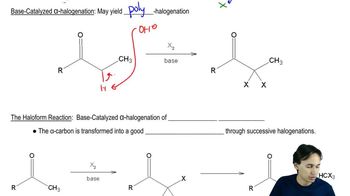
Base Catalyzed

Sugar Isomerization

Isomerization is the process by which one molecule is transformed into another molecule with the same atoms but a different arrangement. In the conversion of d-fructose to d-glucose and d-mannose, the carbon skeleton of the sugar undergoes rearrangement. This process is crucial for understanding how different sugars can be interconverted through specific reaction pathways.
Recommended video:
Guided course
08:42
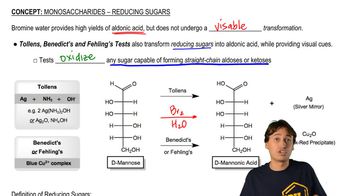
Reducing Sugars

Enolization and Tautomerization

Enolization refers to the conversion of a carbonyl compound into its enol form, which contains a double bond and an alcohol group. Tautomerization is the rapid interconversion between the enol and keto forms. In the context of d-fructose conversion, enolization plays a key role in facilitating the rearrangement to produce d-glucose and d-mannose, highlighting the importance of these structural forms in sugar chemistry.
Recommended video:
Guided course
05:11
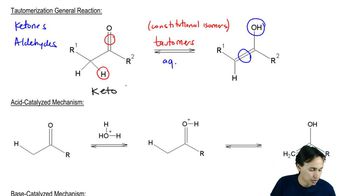
Tautomerization Mechanisms