Ch. 20 - Carboxylic Acids
Wade - Organic Chemistry 9th Edition
Wade9th EditionOrganic ChemistryISBN: 9780135213728Not the one you use?Change textbook
Chapter 20, Problem 11f

Show how you would synthesize the following carboxylic acids, using the indicated starting materials.
(f) allyl iodide → but-3-enoic acid

Verified step by step guidance
1
Step 1: Begin by identifying the functional groups in the starting material (allyl iodide) and the target molecule (but-3-enoic acid). Allyl iodide contains an alkyl halide group, while but-3-enoic acid contains a carboxylic acid group and a double bond.
Step 2: Plan the synthesis by considering the transformation of the alkyl halide into a carboxylic acid. A common method involves converting the alkyl halide into a Grignard reagent, which can then react with carbon dioxide to form a carboxylic acid.
Step 3: React allyl iodide with magnesium in dry ether to form allyl magnesium iodide, a Grignard reagent. The reaction can be represented as: CH(2)CH(2)I+MgCH(2)CH(2)MgI
Step 4: Bubble carbon dioxide gas through the Grignard reagent solution to form the carboxylic acid intermediate. The reaction can be represented as: CH(2)CH(2)MgI+CO2CH(2)CH(2)COOH
Step 5: Perform an acidic workup (e.g., using dilute HCl) to protonate the carboxylate ion and isolate the final product, but-3-enoic acid. This step ensures the carboxylic acid is fully formed and purified.

Verified video answer for a similar problem:

This video solution was recommended by our tutors as helpful for the problem above.
Video duration:
1m
Was this helpful?

Key Concepts

Here are the essential concepts you must grasp in order to answer the question correctly.

Carboxylic Acid Synthesis

Carboxylic acids can be synthesized through various methods, including oxidation of alcohols, hydrolysis of nitriles, and carbon chain elongation. Understanding the functional groups and reactivity of starting materials is crucial for determining the appropriate synthetic route. In this case, the transformation of allyl iodide to but-3-enoic acid involves strategic manipulation of carbon skeletons and functional groups.
Recommended video:
Guided course
04:20
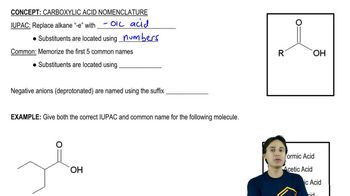
Carboxylic Acids Nomenclature

Allyl Iodide Reactivity

Allyl iodide is a reactive alkyl halide that can undergo nucleophilic substitution and elimination reactions. Its structure allows for the formation of a double bond through elimination, which is essential for synthesizing alkenes. Recognizing how allyl iodide can be transformed into intermediates that lead to the desired carboxylic acid is key to solving the synthesis problem.
Recommended video:
Guided course
03:20
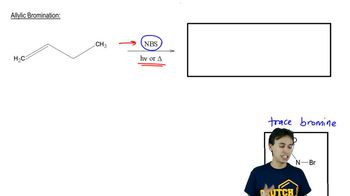
Specific Reactions - Allylic Bromination

Carbon Chain Elongation

Carbon chain elongation involves adding carbon atoms to a molecule, often through reactions like Grignard reactions or alkylation. In the context of synthesizing but-3-enoic acid, understanding how to extend the carbon chain from allyl iodide and subsequently introduce a carboxylic acid functional group is vital. This concept is fundamental in organic synthesis for constructing complex molecules from simpler precursors.
Recommended video:
Guided course
04:25
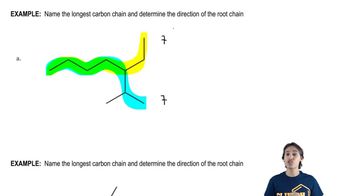
Name the longest carbon chain