
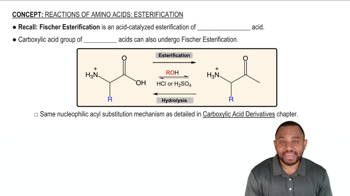
The Principle of Microscopic Reversibility states that a forward reaction and a reverse reaction taking place under the same conditions (as in an equilibrium) must follow the same reaction pathway in microscopic detail. The reverse of the Fischer esterification is the acid-catalyzed hydrolysis of an ester. Propose a mechanism for the acid-catalyzed hydrolysis of ethyl benzoate, PhCOOCH2CH3.
Propose a mechanism for the acid-catalyzed reaction of acetic acid with ethanol to give ethyl acetate.
Verified step by step guidance
Verified video answer for a similar problem:
Key Concepts
Acid-Catalyzed Reactions
Esterification
Reaction Mechanism
Show how Fischer esterification might be used to form the following esters. In each case, suggest a method for driving the reaction to completion.
(a) methyl salicylate
Show how you would synthesize the following carboxylic acids, using the indicated starting materials.
(e) p-xylene → terephthalic acid
Show how you would synthesize the following carboxylic acids, using the indicated starting materials.
(f) allyl iodide → but-3-enoic acid
A carboxylic acid has two oxygen atoms, each with two nonbonding pairs of electrons.
(a) Draw the resonance forms of a carboxylic acid that is protonated on the hydroxy oxygen atom.
(b) Compare the resonance forms with those given previously for an acid protonated on the carbonyl oxygen atom.
(c) Explain why the carbonyl oxygen atom of a carboxylic acid is more basic than the hydroxy oxygen.
Show how you would synthesize the following carboxylic acids, using the indicated starting materials.
(d) butan-2-ol → 2-methylbutanoic acid
