Ch. 20 - Carboxylic Acids
Wade - Organic Chemistry 9th Edition
Wade9th EditionOrganic ChemistryISBN: 9780135213728Not the one you use?Change textbook
Chapter 20, Problem 15a

Show how Fischer esterification might be used to form the following esters. In each case, suggest a method for driving the reaction to completion.
(a) methyl salicylate

Verified step by step guidance
1
Step 1: Understand the Fischer esterification process. Fischer esterification is an acid-catalyzed reaction between a carboxylic acid and an alcohol to form an ester and water. The general reaction can be represented as: RCOOH+ROHRCOOR+H2O. This reaction typically requires a strong acid catalyst, such as sulfuric acid.
Step 2: Identify the reactants needed to form methyl salicylate. Methyl salicylate is an ester derived from salicylic acid (a carboxylic acid) and methanol (an alcohol). The chemical structure of salicylic acid includes both a carboxylic acid group and a phenolic hydroxyl group, but only the carboxylic acid group participates in the esterification reaction.
Step 3: Write the reaction equation for the formation of methyl salicylate. The reaction can be represented as: C7H6O3+CH3OHC8H8O3+H2O. Here, salicylic acid reacts with methanol in the presence of an acid catalyst to form methyl salicylate and water.
Step 4: Suggest a method to drive the reaction to completion. Since Fischer esterification is an equilibrium reaction, Le Chatelier's principle can be applied to shift the equilibrium toward the ester product. This can be achieved by: (a) using an excess of methanol to drive the reaction forward, or (b) removing the water formed during the reaction, such as by using a Dean-Stark apparatus or drying agents.
Step 5: Highlight the importance of the acid catalyst. Add a strong acid catalyst, such as concentrated sulfuric acid, to protonate the carboxylic acid group and make it more electrophilic, thereby facilitating the nucleophilic attack by methanol. Ensure the reaction mixture is heated gently to increase the reaction rate without decomposing the reactants or products.

Verified video answer for a similar problem:

This video solution was recommended by our tutors as helpful for the problem above.
Video duration:
5m
Was this helpful?

Key Concepts

Here are the essential concepts you must grasp in order to answer the question correctly.

Fischer Esterification

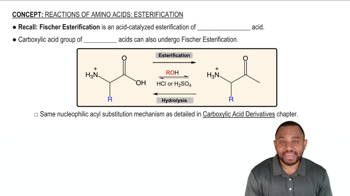
Fischer esterification is a chemical reaction that forms an ester from a carboxylic acid and an alcohol in the presence of an acid catalyst. The reaction typically involves the nucleophilic attack of the alcohol on the carbonyl carbon of the acid, leading to the formation of the ester and water. This reaction is reversible, so conditions must be manipulated to drive it toward ester formation.
Recommended video:
1:21
Reactions of Amino Acids: Esterification Concept 1

Le Chatelier's Principle

Le Chatelier's Principle states that if a dynamic equilibrium is disturbed by changing the conditions, the system will adjust to counteract the change and restore a new equilibrium. In the context of Fischer esterification, this principle can be applied by removing water or using excess reactants to shift the equilibrium toward the formation of the ester, thus driving the reaction to completion.
Recommended video:
Guided course
04:12
The Electron Configuration

Methyl Salicylate

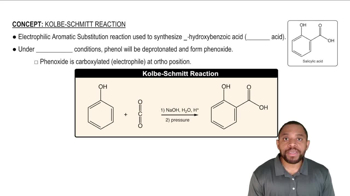
Methyl salicylate is an ester formed from salicylic acid and methanol. It is commonly used in flavoring and fragrance applications and has anti-inflammatory properties. Understanding its structure and the specific reactants involved in its synthesis through Fischer esterification is crucial for effectively proposing methods to drive the reaction to completion.
Recommended video:
2:08
Kolbe-Schmidt Reaction Concept 1
Related Practice
Textbook Question

Show how Fischer esterification might be used to form the following esters. In each case, suggest a method for driving the reaction to completion.

(c) ethyl phenylacetate

6
views

Textbook Question

Propose a mechanism for the acid-catalyzed reaction of acetic acid with ethanol to give ethyl acetate.

6
views
Textbook Question

The mechanism of the Fischer esterification was controversial until 1938, when Irving Roberts and Harold Urey of Columbia University used isotopic labeling to follow the alcohol oxygen atom through the reaction. A catalytic amount of sulfuric acid was added to a mixture of 1 mole of acetic acid and 1 mole of special methanol containing the heavy 18O isotope of oxygen. After a short period, the acid was neutralized to stop the reaction, and the components of the mixture were separated.

(a) Propose a mechanism for this reaction.

(b) Follow the labeled 18O atom through your mechanism, and show where it is found in the products.

1
views
Textbook Question

The Principle of Microscopic Reversibility states that a forward reaction and a reverse reaction taking place under the same conditions (as in an equilibrium) must follow the same reaction pathway in microscopic detail. The reverse of the Fischer esterification is the acid-catalyzed hydrolysis of an ester. Propose a mechanism for the acid-catalyzed hydrolysis of ethyl benzoate, PhCOOCH2CH3.

5
views
Textbook Question

What monosaccharides are formed in a modified Kiliani–Fischer synthesis starting with each of the following monosaccharides?

b. L-threose

2
views
Textbook Question

A carboxylic acid has two oxygen atoms, each with two nonbonding pairs of electrons.

(a) Draw the resonance forms of a carboxylic acid that is protonated on the hydroxy oxygen atom.

(b) Compare the resonance forms with those given previously for an acid protonated on the carbonyl oxygen atom.

(c) Explain why the carbonyl oxygen atom of a carboxylic acid is more basic than the hydroxy oxygen.

7
views