Ch. 19 - Amines
Wade - Organic Chemistry 9th Edition
Wade9th EditionOrganic ChemistryISBN: 9780135213728Not the one you use?Change textbook
Chapter 19, Problem 38c,d

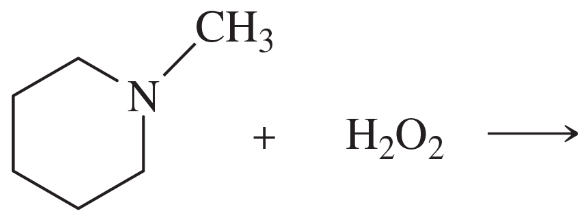
Predict the products of the following reactions:
(c)
(d)

Verified step by step guidance
1
Step 1: Analyze reaction A. The starting material is N-methylpiperidine reacting with hydrogen peroxide (H₂O₂). This reaction typically involves oxidation of the nitrogen atom in the amine group.
Step 2: Predict the intermediate product of reaction A. Hydrogen peroxide oxidizes the nitrogen atom, forming an N-oxide. The structure of the product will have an oxygen atom bonded to the nitrogen, creating a piperidine N-oxide.
Step 3: Analyze reaction B. The product of reaction A (piperidine N-oxide) is subjected to heat (Δ). Heating an N-oxide can lead to a Cope elimination reaction, which involves the elimination of a molecule to form a double bond.
Step 4: Predict the product of reaction B. The Cope elimination results in the formation of an alkene. Specifically, the elimination occurs between the β-hydrogen and the nitrogen-oxide group, leading to the formation of a double bond in the piperidine ring.
Step 5: Verify the stereochemistry and regiochemistry of the final product. Ensure that the double bond is correctly placed in the ring structure based on the elimination mechanism.

Verified video answer for a similar problem:

This video solution was recommended by our tutors as helpful for the problem above.
Video duration:
4m
Was this helpful?

Key Concepts

Here are the essential concepts you must grasp in order to answer the question correctly.

Amine Reactivity

Amines are organic compounds derived from ammonia by replacing one or more hydrogen atoms with alkyl or aryl groups. They can act as nucleophiles due to the lone pair of electrons on the nitrogen atom, allowing them to participate in various reactions, including oxidation and substitution. Understanding the reactivity of amines is crucial for predicting the products of reactions involving them.
Recommended video:
Guided course
07:12
Reductive Amination

Oxidation Reactions

Oxidation reactions involve the loss of electrons or an increase in oxidation state by a molecule, atom, or ion. In the context of amines, hydrogen peroxide (H2O2) is a common oxidizing agent that can convert primary and secondary amines into their corresponding N-oxides or other oxidized products. Recognizing the role of oxidizing agents is essential for predicting the outcome of reactions involving amines.
Recommended video:
Guided course
03:20
Benzylic Oxidation

Reaction Mechanisms

Understanding reaction mechanisms is vital for predicting the products of chemical reactions. A mechanism outlines the step-by-step process by which reactants are converted into products, including the formation and breaking of bonds. In the case of the reaction between an amine and hydrogen peroxide, knowing the mechanism helps in anticipating the specific product formed and any intermediates that may arise during the reaction.
Recommended video:
Guided course
02:16
Heck Reaction Mechanism