Ch. 19 - Amines
Wade - Organic Chemistry 9th Edition
Wade9th EditionOrganic ChemistryISBN: 9780135213728Not the one you use?Change textbook
Chapter 19, Problem 37a,b

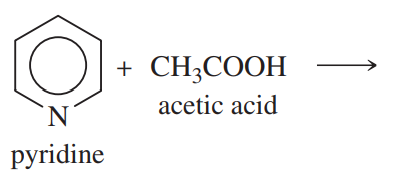
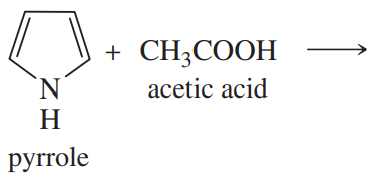
Complete the following proposed acid–base reactions, and predict whether the reactants or products are favored.
(a)
(b) Pyrrole reacts with acetic acid, indicating a proposed acid-base reaction with products and reactants.

Verified step by step guidance
1
Identify the acid and base in each reaction. The acid is the species that donates a proton (H⁺), and the base is the species that accepts a proton.
Write the chemical equation for each reaction, showing the transfer of a proton from the acid to the base. Use curved arrows to indicate the movement of electrons.
Determine the conjugate acid and conjugate base formed in each reaction. The conjugate acid is the species formed when the base gains a proton, and the conjugate base is the species formed when the acid loses a proton.
Compare the strength of the acid and its conjugate acid, as well as the base and its conjugate base. Use pKa values or known acid/base strength trends to assess which side of the reaction is favored.
Predict the direction of the equilibrium. The reaction will favor the side with the weaker acid and base, as the system tends to move towards the formation of more stable (less reactive) species.

Verified video answer for a similar problem:

This video solution was recommended by our tutors as helpful for the problem above.
Video duration:
5m
Was this helpful?

Key Concepts

Here are the essential concepts you must grasp in order to answer the question correctly.

Acid-Base Theory

Acid-base theory explains the behavior of acids and bases in chemical reactions. According to the Brønsted-Lowry theory, acids are proton donors while bases are proton acceptors. Understanding this concept is crucial for predicting the direction of acid-base reactions and determining the strength of the acids and bases involved.
Recommended video:
Guided course
02:49
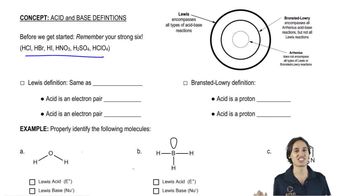
The Lewis definition of acids and bases.

Equilibrium and Le Chatelier's Principle

Chemical equilibrium occurs when the rates of the forward and reverse reactions are equal, resulting in constant concentrations of reactants and products. Le Chatelier's Principle states that if a system at equilibrium is disturbed, it will shift in a direction that counteracts the disturbance. This principle helps predict whether reactants or products are favored in acid-base reactions.
Recommended video:
Guided course
04:00
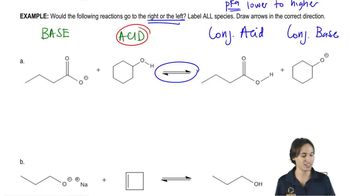
Determining Acid/Base Equilibrium

pKa and pKb Values

The pKa and pKb values are measures of the strength of acids and bases, respectively. A lower pKa indicates a stronger acid, while a lower pKb indicates a stronger base. These values are essential for predicting the outcome of acid-base reactions, as they provide insight into the relative strengths of the reactants and products involved.
Recommended video:
Guided course
07:45
Identifying pKa values