Ch. 18 - Ketones and Aldehydes
Wade - Organic Chemistry 9th Edition
Wade9th EditionOrganic ChemistryISBN: 9780135213728Not the one you use?Change textbook
Chapter 18, Problem 39f

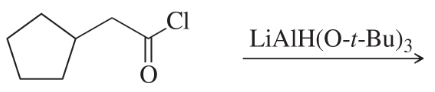
Predict the major products of the following reactions.
(f)

Verified step by step guidance
1
Step 1: Identify the functional group in the starting material. The compound contains an acyl chloride group (-COCl), which is highly reactive and can undergo reduction reactions.
Step 2: Recognize the reagent used in the reaction. Lithium tri-tert-butoxyaluminum hydride (LiAlH(O-t-Bu)₃) is a selective reducing agent that reduces acyl chlorides to aldehydes without further reducing the aldehyde to an alcohol.
Step 3: Predict the mechanism of the reaction. The hydride ion (H⁻) from the reagent attacks the carbonyl carbon of the acyl chloride, leading to the formation of an aldehyde intermediate. The bulky tert-butoxy groups prevent further reduction of the aldehyde.
Step 4: Analyze the structure of the product. The acyl chloride group is converted into an aldehyde group (-CHO), while the rest of the molecule remains unchanged.
Step 5: Write the major product. The major product will be the compound with the aldehyde functional group replacing the acyl chloride group. Ensure the cyclic structure and substituents are preserved in the final product.

Verified video answer for a similar problem:

This video solution was recommended by our tutors as helpful for the problem above.
Video duration:
1m
Was this helpful?

Key Concepts

Here are the essential concepts you must grasp in order to answer the question correctly.

Reduction Reactions

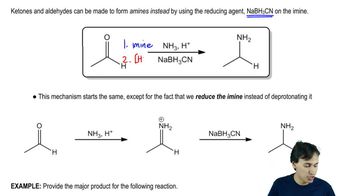
Reduction reactions involve the gain of electrons or the decrease in oxidation state by a molecule. In organic chemistry, this often refers to the conversion of carbonyl compounds (like aldehydes and ketones) to alcohols. The reagent used in the provided reaction, LiAlH(O-t-Bu)3, is a selective reducing agent that can effectively reduce carbonyl groups while minimizing side reactions.
Recommended video:
Guided course
07:12
Reductive Amination

Lithium Aluminum Hydride (LiAlH4)

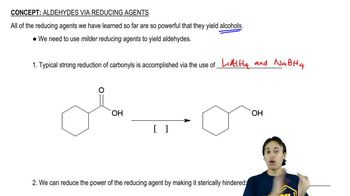
Lithium Aluminum Hydride (LiAlH4) is a powerful reducing agent commonly used in organic synthesis to reduce a variety of functional groups, including esters, carboxylic acids, and aldehydes. The variant LiAlH(O-t-Bu)3 is a milder form that selectively reduces carbonyls to alcohols without affecting other functional groups, making it useful for complex molecules.
Recommended video:
Guided course
02:07
Why LiAlH4 doesn't work

Mechanism of Nucleophilic Attack

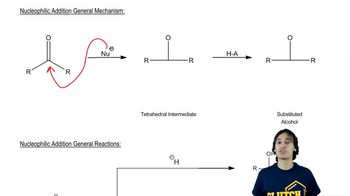
The mechanism of nucleophilic attack is fundamental in organic reactions, where a nucleophile donates an electron pair to an electrophile, forming a new bond. In the context of the reaction shown, the hydride ion from LiAlH(O-t-Bu)3 acts as a nucleophile, attacking the electrophilic carbon of the carbonyl group, leading to the formation of an alcohol as the major product.
Recommended video:
Guided course
08:27
Nucleophilic Addition