Ch. 18 - Ketones and Aldehydes
Wade - Organic Chemistry 9th Edition
Wade9th EditionOrganic ChemistryISBN: 9780135213728Not the one you use?Change textbook
Chapter 18, Problem 39h

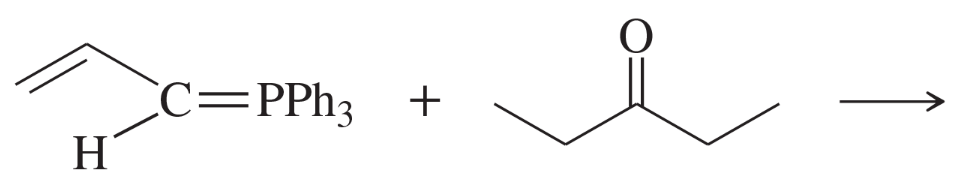
Predict the major products of the following reactions.
(h)

Verified step by step guidance
1
Step 1: Identify the reaction type. The given reaction involves a Wittig reagent (Ph₃P=CHR) and a ketone. This is a Wittig reaction, which is used to form alkenes by reacting a phosphonium ylide with a carbonyl compound.
Step 2: Analyze the reactants. The Wittig reagent contains a phosphonium ylide (Ph₃P=CH-CH=CH₂), and the ketone is acetone (CH₃COCH₃). The ylide will react with the carbonyl group of the ketone.
Step 3: Determine the mechanism. The Wittig reaction proceeds via nucleophilic attack of the ylide carbon on the carbonyl carbon, forming a betaine intermediate. This intermediate rearranges to form an oxaphosphetane, which then decomposes to yield the alkene product and triphenylphosphine oxide (Ph₃P=O).
Step 4: Predict the product. The alkene formed will result from the combination of the carbonyl carbon and the ylide carbon. The double bond will replace the oxygen atom of the ketone, and the substituents from both reactants will determine the structure of the alkene.
Step 5: Consider stereochemistry. Wittig reactions can produce E/Z isomers depending on the steric and electronic properties of the reactants. In this case, analyze the substituents to predict the major stereoisomer.

Verified video answer for a similar problem:

This video solution was recommended by our tutors as helpful for the problem above.
Video duration:
4m
Was this helpful?

Key Concepts

Here are the essential concepts you must grasp in order to answer the question correctly.

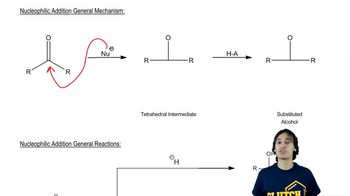
Nucleophilic Addition

Nucleophilic addition is a fundamental reaction in organic chemistry where a nucleophile attacks an electrophilic carbon atom, typically in carbonyl compounds. This process results in the formation of a new bond, leading to the conversion of a carbonyl group (C=O) into an alcohol (C-OH) or other functional groups. Understanding this mechanism is crucial for predicting the products of reactions involving carbonyl compounds.
Recommended video:
Guided course
08:27
Nucleophilic Addition

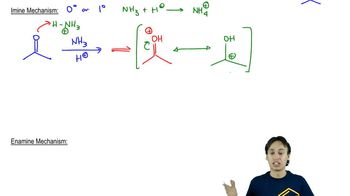
Imine Formation

Imine formation occurs when a primary amine reacts with a carbonyl compound, resulting in the creation of an imine (C=N) through a condensation reaction. This process involves the nucleophilic attack of the amine on the carbonyl carbon, followed by the elimination of water. Recognizing how imines can act as nucleophiles in subsequent reactions is essential for predicting the outcomes of reactions involving imines.
Recommended video:
Guided course
06:23
Imine Mechanism

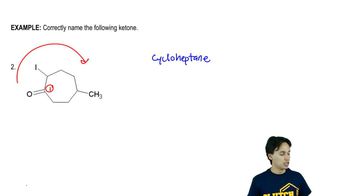
Reactivity of Ketones

Ketones are organic compounds characterized by a carbonyl group (C=O) flanked by two carbon atoms. Their reactivity is influenced by the presence of electron-donating or withdrawing groups, which can stabilize or destabilize the carbonyl carbon. Understanding the reactivity of ketones is vital for predicting how they will interact with nucleophiles, such as imines, in various organic reactions.
Recommended video:
Guided course
02:27
Name the ketone