Ch. 18 - Ketones and Aldehydes
Wade - Organic Chemistry 9th Edition
Wade9th EditionOrganic ChemistryISBN: 9780135213728Not the one you use?Change textbook
Chapter 18, Problem 39d

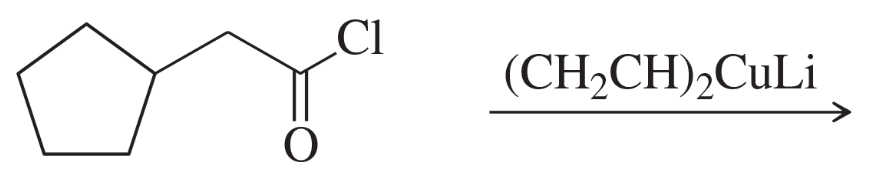
Predict the major products of the following reactions.
(d)

Verified step by step guidance
1
Step 1: Recognize the type of reaction. The reaction involves an acyl chloride (RCOCl) and a Gilman reagent ((R')2CuLi). Gilman reagents are organocuprates that selectively react with acyl chlorides to form ketones.
Step 2: Analyze the reactants. The acyl chloride in the reaction is cyclopentylacetyl chloride, and the Gilman reagent is (CH2=CH)2CuLi, which contains two vinyl groups (CH2=CH). The vinyl group will replace the chlorine atom in the acyl chloride.
Step 3: Understand the mechanism. The Gilman reagent donates one of its alkyl groups (CH2=CH) to the carbonyl carbon of the acyl chloride, displacing the chloride ion (Cl-) and forming a ketone. This reaction proceeds via nucleophilic acyl substitution.
Step 4: Predict the product structure. The product will be a ketone where the carbonyl group is bonded to the cyclopentyl group on one side and the vinyl group (CH2=CH) on the other side.
Step 5: Verify the major product. Since Gilman reagents are highly selective, the major product will be cyclopentyl vinyl ketone, with no side reactions or over-reduction occurring.

Verified video answer for a similar problem:

This video solution was recommended by our tutors as helpful for the problem above.
Video duration:
2m
Was this helpful?

Key Concepts

Here are the essential concepts you must grasp in order to answer the question correctly.

Nucleophilic Substitution

Nucleophilic substitution is a fundamental reaction in organic chemistry where a nucleophile attacks an electrophile, resulting in the replacement of a leaving group. In this case, the chlorine atom in the compound acts as a leaving group, and the organocuprate reagent, (CH2CH)2CuLi, serves as the nucleophile, facilitating the substitution reaction.
Recommended video:
Guided course
01:47
Nucleophiles and Electrophiles can react in Substitution Reactions.

Organocuprates

Organocuprates, such as (CH2CH)2CuLi, are organometallic compounds that are highly reactive nucleophiles. They are particularly useful in organic synthesis for performing nucleophilic substitutions and additions to carbonyl compounds. Their ability to react selectively with electrophiles makes them valuable in forming carbon-carbon bonds.

Reactivity of Carbonyl Compounds

Carbonyl compounds, characterized by the C=O functional group, exhibit significant reactivity due to the polarization of the carbon-oxygen bond. In this reaction, the carbonyl carbon is electrophilic, making it susceptible to attack by nucleophiles. Understanding the reactivity of carbonyls is crucial for predicting the products of reactions involving these compounds.
Recommended video:
Guided course
01:40
Defining meso compounds.