Ch. 18 - Ketones and Aldehydes
Wade - Organic Chemistry 9th Edition
Wade9th EditionOrganic ChemistryISBN: 9780135213728Not the one you use?Change textbook
Chapter 18, Problem 39b

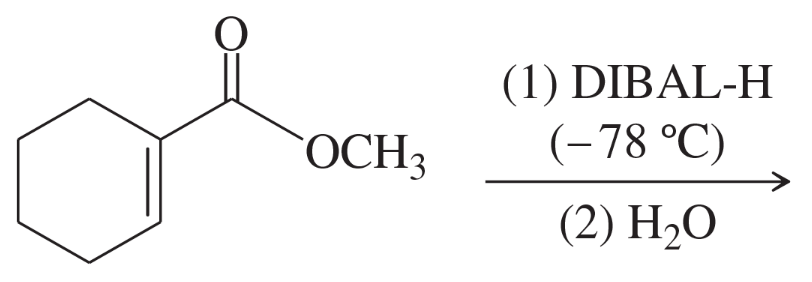
Predict the major products of the following reactions.
(b)

Verified step by step guidance
1
Step 1: Analyze the given reaction. The starting material is a methyl ester (RCOOCH3) attached to a cyclohexene ring. The reagents are DIBAL-H (Diisobutylaluminum hydride) at -78°C followed by hydrolysis with water.
Step 2: Understand the role of DIBAL-H. At low temperatures (-78°C), DIBAL-H selectively reduces esters to aldehydes without further reduction to alcohols. This is due to the controlled reaction conditions.
Step 3: Predict the intermediate. DIBAL-H will attack the carbonyl carbon of the ester, breaking the C=O bond and forming an aluminum complex. Upon hydrolysis with water, the aluminum complex is converted into an aldehyde.
Step 4: Consider the structure of the product. The methyl ester group (-COOCH3) will be reduced to an aldehyde group (-CHO), while the cyclohexene ring remains intact.
Step 5: Write the major product. The major product will be cyclohexene with an aldehyde group attached to the same carbon where the ester group was originally located.

Verified video answer for a similar problem:

This video solution was recommended by our tutors as helpful for the problem above.
Video duration:
6m
Was this helpful?

Key Concepts

Here are the essential concepts you must grasp in order to answer the question correctly.

DIBAL-H Reduction

DIBAL-H (Diisobutylaluminum hydride) is a selective reducing agent used in organic chemistry to reduce esters and other carbonyl compounds to aldehydes. At low temperatures, such as -78 °C, DIBAL-H can stop the reduction at the aldehyde stage, preventing further reduction to alcohols. Understanding this selective reduction is crucial for predicting the products of the reaction shown.
Recommended video:
Guided course
02:10
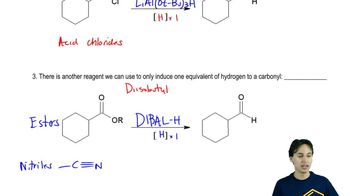
DIBAL-H on Esters and Nitriles

Mechanism of Carbonyl Reduction

The mechanism of carbonyl reduction involves the nucleophilic attack of the hydride ion from DIBAL-H on the electrophilic carbon of the carbonyl group. This leads to the formation of a tetrahedral intermediate, which can collapse to form either an aldehyde or an alcohol, depending on the reaction conditions. Recognizing this mechanism helps in predicting the major product of the reaction.
Recommended video:
Guided course
04:40
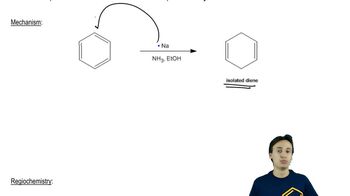
Birch Reduction Mechanism

Hydrolysis of Aldehydes

After the reduction step, the addition of water (H2O) typically leads to hydrolysis of the formed aldehyde. This step involves the reaction of the aldehyde with water, resulting in the formation of an alcohol. Understanding this hydrolysis process is essential for determining the final product of the reaction sequence presented.
Recommended video:
Guided course
01:34
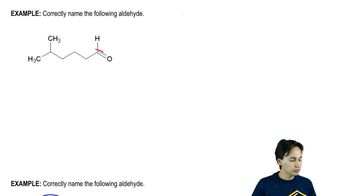
Name the aldehyde