Ch. 17 - Reactions of Aromatic Compounds
Wade - Organic Chemistry 9th Edition
Wade9th EditionOrganic ChemistryISBN: 9780135213728Not the one you use?Change textbook
Chapter 17, Problem 25

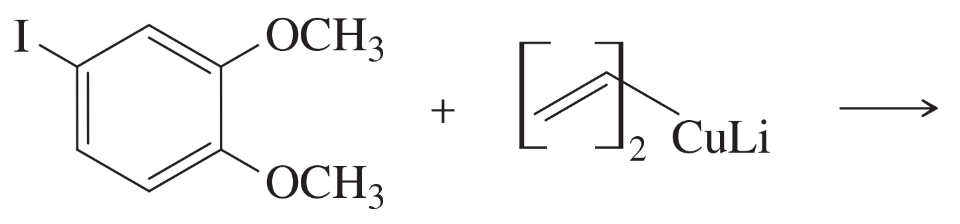
What products would you expect from the following reactions?
(a)
(b)

Verified step by step guidance
1
Analyze the reactants and reaction conditions for each part (a) and (b). Identify the functional groups present in the reactants and the type of reaction (e.g., substitution, elimination, addition, etc.).
For part (a), determine the mechanism of the reaction based on the reagents and conditions provided. For example, if a strong nucleophile is present, consider a nucleophilic substitution (SN1 or SN2) or elimination (E1 or E2) pathway.
Write the step-by-step mechanism for part (a), showing how the reactants transform into the products. Use curved arrows to indicate the movement of electrons and ensure all intermediates are accounted for.
For part (b), repeat the process: identify the reaction type and mechanism based on the reactants and conditions. Consider factors such as the presence of catalysts, heat, or specific reagents that might favor a particular pathway.
Draw the final products for both (a) and (b), ensuring that all stereochemistry, regiochemistry, and functional group transformations are correctly represented. Double-check the stability of the products and intermediates to confirm the plausibility of the reaction pathways.

Verified video answer for a similar problem:

This video solution was recommended by our tutors as helpful for the problem above.
Video duration:
6m
Was this helpful?

Key Concepts

Here are the essential concepts you must grasp in order to answer the question correctly.

Reaction Mechanisms

Understanding reaction mechanisms is crucial in organic chemistry as they describe the step-by-step process by which reactants transform into products. This includes identifying intermediates, transition states, and the movement of electrons. Familiarity with mechanisms helps predict the products of reactions based on the types of reactants and conditions involved.
Recommended video:
Guided course
02:16
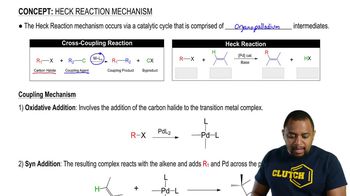
Heck Reaction Mechanism

Functional Groups

Functional groups are specific groups of atoms within molecules that are responsible for the characteristic chemical reactions of those molecules. Recognizing functional groups allows chemists to predict how different compounds will react and what products will form. Common functional groups include alcohols, carboxylic acids, and amines, each influencing reactivity and product formation.
Recommended video:
Guided course
02:36
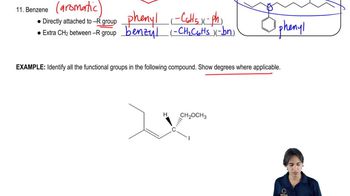
Identifying Functional Groups

Reagents and Conditions

The choice of reagents and reaction conditions (such as temperature, pressure, and solvent) significantly affects the outcome of organic reactions. Different reagents can lead to various pathways and products, while specific conditions can favor certain reactions over others. Understanding how these factors interact is essential for predicting the products of organic reactions.
Recommended video: