Ch. 17 - Reactions of Aromatic Compounds
Wade - Organic Chemistry 9th Edition
Wade9th EditionOrganic ChemistryISBN: 9780135213728Not the one you use?Change textbook
Chapter 17, Problem 26

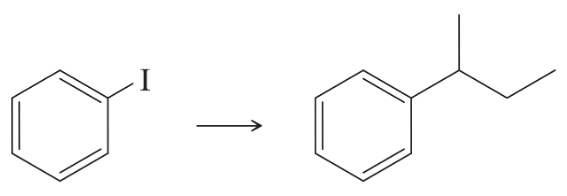
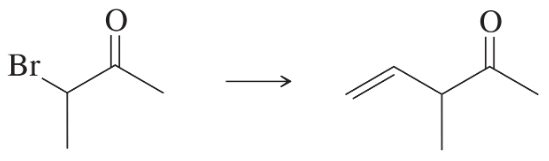
What organocuprate reagent would you use for the following substitutions?
(a)
(b)

Verified step by step guidance
1
Step 1: Analyze the transformations in both reactions. In (i), the iodine atom on the benzene ring is replaced by an alkyl group. In (ii), the bromine atom on the α-carbon of a ketone is replaced by an alkyl group.
Step 2: Recognize that organocuprate reagents (R2CuLi) are commonly used for substitution reactions where halides are replaced by alkyl groups. These reagents are nucleophilic and can perform SN2-type substitutions.
Step 3: For reaction (i), identify the alkyl group being introduced (isopropyl group). The organocuprate reagent required would be (CH3)2CHCuLi, where the isopropyl group is the nucleophile.
Step 4: For reaction (ii), identify the alkyl group being introduced (ethyl group). The organocuprate reagent required would be CH3CH2CuLi, where the ethyl group is the nucleophile.
Step 5: Ensure the reaction conditions are suitable for organocuprate substitution, typically involving a polar aprotic solvent like THF and low temperatures to prevent side reactions.

Verified video answer for a similar problem:

This video solution was recommended by our tutors as helpful for the problem above.
Video duration:
6m
Was this helpful?

Key Concepts

Here are the essential concepts you must grasp in order to answer the question correctly.

Organocuprate Reagents

Organocuprates, or Gilman reagents, are organometallic compounds containing copper that are used in nucleophilic substitution reactions. They are typically formed by reacting an organolithium compound with copper(I) halides. These reagents are particularly useful for performing substitutions on alkyl halides, allowing for the formation of carbon-carbon bonds in organic synthesis.
Recommended video:

Nucleophilic Substitution Mechanisms

Nucleophilic substitution is a fundamental reaction in organic chemistry where a nucleophile replaces a leaving group in a molecule. The two main mechanisms are SN1, which involves a two-step process with a carbocation intermediate, and SN2, which is a one-step process where the nucleophile attacks the substrate simultaneously as the leaving group departs. Understanding these mechanisms is crucial for predicting the outcomes of reactions involving organocuprates.
Recommended video:
Guided course
01:47
Nucleophiles and Electrophiles can react in Substitution Reactions.

Stereochemistry in Substitution Reactions

Stereochemistry refers to the spatial arrangement of atoms in molecules and is critical in substitution reactions. In SN2 reactions, the nucleophile attacks from the opposite side of the leaving group, leading to inversion of configuration at the chiral center. In contrast, SN1 reactions can lead to racemic mixtures due to the planar nature of the carbocation intermediate. Recognizing the stereochemical implications is essential for predicting the products of reactions involving organocuprates.
Recommended video:
1:38
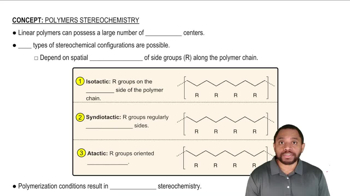
Polymer Stereochemistry Concept 1