Ch. 17 - Reactions of Aromatic Compounds
Wade - Organic Chemistry 9th Edition
Wade9th EditionOrganic ChemistryISBN: 9780135213728Not the one you use?Change textbook
Chapter 17, Problem 23c,d

Propose mechanisms and show the expected products of the following reactions.
(c) p-nitrobromobenzene + methylamine (CH3–NH2)
(d) 2,4-dinitrochlorobenzene + excess hydrazine (H2N–NH2)

Verified step by step guidance
1
Step 1: Recognize the type of reaction occurring in each case. Both reactions involve nucleophilic aromatic substitution (NAS), which is common for aromatic compounds with electron-withdrawing groups (like nitro groups) and halogens (like bromine or chlorine). These electron-withdrawing groups activate the aromatic ring for substitution.
Step 2: For reaction (c), identify the nucleophile and electrophile. Methylamine (CH3-NH2) acts as the nucleophile, and p-nitrobromobenzene is the electrophile. The nitro group (-NO2) on the benzene ring is an electron-withdrawing group that stabilizes the intermediate formed during substitution. The bromine atom is the leaving group.
Step 3: Propose the mechanism for reaction (c). The nucleophile (CH3-NH2) attacks the carbon atom of the benzene ring that is bonded to the bromine atom. This forms a Meisenheimer complex (a negatively charged intermediate stabilized by resonance due to the nitro group). Bromine is then eliminated, resulting in the substitution product: p-nitro-N-methylbenzene.
Step 4: For reaction (d), identify the nucleophile and electrophile. Hydrazine (H2N-NH2) acts as the nucleophile, and 2,4-dinitrochlorobenzene is the electrophile. The nitro groups at the 2- and 4-positions strongly activate the benzene ring for substitution, and chlorine is the leaving group.
Step 5: Propose the mechanism for reaction (d). The nucleophile (H2N-NH2) attacks the carbon atom of the benzene ring bonded to the chlorine atom, forming a Meisenheimer complex stabilized by resonance due to the nitro groups. Chlorine is eliminated, resulting in the substitution product: 2,4-dinitrophenylhydrazine. Since excess hydrazine is used, the reaction proceeds efficiently.

Verified video answer for a similar problem:

This video solution was recommended by our tutors as helpful for the problem above.
Video duration:
19m
Was this helpful?

Key Concepts

Here are the essential concepts you must grasp in order to answer the question correctly.

Nucleophilic Aromatic Substitution

Nucleophilic aromatic substitution (NAS) is a reaction where a nucleophile replaces a leaving group on an aromatic ring. This process typically occurs in aromatic compounds that have electron-withdrawing groups, which stabilize the negative charge that develops during the reaction. In the case of p-nitrobromobenzene reacting with methylamine, the amino group acts as a nucleophile, attacking the carbon bonded to the bromine, leading to the substitution.
Recommended video:
Guided course
01:47
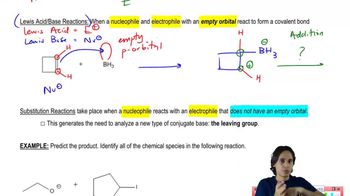
Nucleophiles and Electrophiles can react in Substitution Reactions.

Hydrazine Reactivity

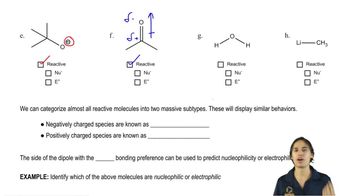
Hydrazine (H2N-NH2) is a strong nucleophile and can react with electrophilic aromatic compounds, particularly those with electron-withdrawing groups like 2,4-dinitrochlorobenzene. The reaction involves the nucleophilic attack of hydrazine on the carbon atom bonded to the chlorine, resulting in the formation of a hydrazone. This reaction is significant in organic synthesis, especially for the preparation of hydrazones from carbonyl compounds.
Recommended video:
Guided course
01:17
Reactivity of Molecules

Electrophilic Aromatic Substitution

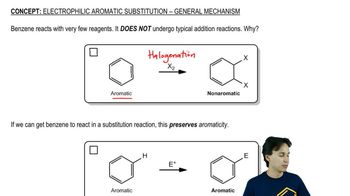
Electrophilic aromatic substitution (EAS) is a fundamental reaction in organic chemistry where an electrophile replaces a hydrogen atom on an aromatic ring. In the context of the reactions provided, the presence of strong electron-withdrawing groups like nitro groups enhances the reactivity of the aromatic ring towards nucleophiles. Understanding EAS is crucial for predicting the products of reactions involving substituted aromatic compounds.
Recommended video: