Ch. 17 - Reactions of Aromatic Compounds
Wade - Organic Chemistry 9th Edition
Wade9th EditionOrganic ChemistryISBN: 9780135213728Not the one you use?Change textbook
Chapter 17, Problem 7

Propose a mechanism for the bromination of ethoxybenzene to give o- and p-bromoethoxybenzene.

Verified step by step guidance
1
Step 1: Begin by identifying the substrate, ethoxybenzene, which is an aromatic compound with an ethoxy (-OCH2CH3) group attached to the benzene ring. The ethoxy group is an electron-donating group, activating the benzene ring and directing electrophilic substitution to the ortho and para positions.
Step 2: Recognize that bromination is an electrophilic aromatic substitution reaction. The bromine molecule (Br2) reacts with a Lewis acid catalyst, such as FeBr3, to generate the electrophile, bromonium ion (Br+). This step can be represented as: Br2+FeBr3Br++FeBr4-
Step 3: The bromonium ion (Br+) acts as the electrophile and attacks the activated benzene ring of ethoxybenzene. Due to the electron-donating nature of the ethoxy group, the ortho and para positions are more electron-rich and thus more reactive toward the electrophile. This results in the formation of a sigma complex (arenium ion) at either the ortho or para position.
Step 4: The sigma complex undergoes deprotonation at the site of substitution to restore aromaticity. A base, such as the FeBr4- anion formed earlier, abstracts the proton from the substituted carbon, regenerating the aromatic ring and yielding o-bromoethoxybenzene or p-bromoethoxybenzene.
Step 5: Conclude by noting that the reaction typically produces a mixture of ortho and para isomers, with the para isomer often being the major product due to steric hindrance at the ortho position. The final products are o-bromoethoxybenzene and p-bromoethoxybenzene.

Verified video answer for a similar problem:

This video solution was recommended by our tutors as helpful for the problem above.
Video duration:
17m
Was this helpful?

Key Concepts

Here are the essential concepts you must grasp in order to answer the question correctly.

Electrophilic Aromatic Substitution

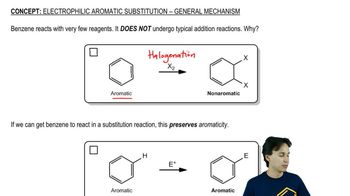
Electrophilic aromatic substitution (EAS) is a fundamental reaction mechanism in organic chemistry where an electrophile replaces a hydrogen atom on an aromatic ring. In the case of bromination, bromine acts as the electrophile, and the presence of activating groups, like the ethoxy group in ethoxybenzene, influences the position of substitution, favoring ortho and para products.
Recommended video:

Resonance and Activating Groups

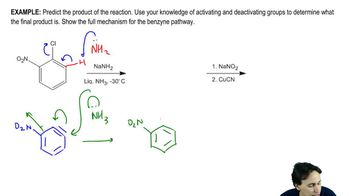
Resonance refers to the delocalization of electrons in a molecule, which stabilizes the structure. The ethoxy group is an electron-donating group that increases the electron density on the aromatic ring, making it more reactive towards electrophiles. This resonance effect explains why bromination occurs predominantly at the ortho and para positions relative to the ethoxy group.
Recommended video:
Guided course
03:27
Activating and deactivating groups

Bromination Mechanism

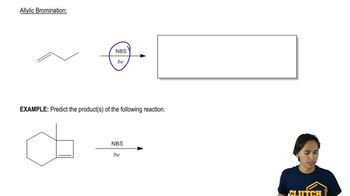
The bromination mechanism involves the generation of a bromonium ion from bromine, which then reacts with the aromatic compound. The first step is the formation of the electrophile, followed by the attack of the aromatic ring, leading to the formation of a sigma complex. Finally, deprotonation restores aromaticity, yielding the bromoethoxybenzene products.
Recommended video:
Guided course
00:54
Mechanism of Allylic Bromination.