
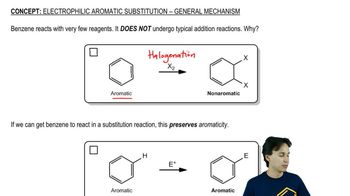
Step 2 of the iodination of benzene shows water acting as a base and removing a proton from the sigma complex. We did not consider the possibility of water acting as a nucleophile and attacking the carbocation, as in an electrophilic addition to an alkene. Draw the reaction that would occur if water reacted as a nucleophile and added to the carbocation. Explain why this type of addition is rarely observed.
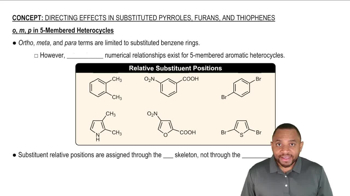
(b) Explain why m-xylene undergoes nitration 100 times faster than p-xylene.
Verified step by step guidance
Verified video answer for a similar problem:
Key Concepts
Electrophilic Aromatic Substitution
Substituent Effects
Resonance Stabilization
Propose a mechanism for the aluminum chloride–catalyzed reaction of benzene with chlorine.
Styrene (vinylbenzene) undergoes electrophilic aromatic substitution much faster than benzene, and the products are found to be primarily ortho- and para-substituted styrenes. Use resonance forms of the intermediates to explain these results.
p-Xylene undergoes nitration much faster than benzene. Use resonance forms of the sigma complex to explain this accelerated rate
Propose a mechanism for the bromination of ethoxybenzene to give o- and p-bromoethoxybenzene.
When bromine is added to two beakers, one containing phenyl isopropyl ether and the other containing cyclohexene, the bromine color in both beakers disappears. What observation could you make while performing this test that would allow you to distinguish the alkene from the aryl ether?
