
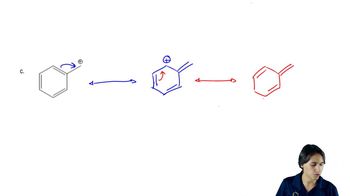
Styrene (vinylbenzene) undergoes electrophilic aromatic substitution much faster than benzene, and the products are found to be primarily ortho- and para-substituted styrenes. Use resonance forms of the intermediates to explain these results.
Ch. 17 - Reactions of Aromatic Compounds
Chapter 17, Problem 10c
In an aqueous solution containing sodium bicarbonate, aniline reacts quickly with bromine to give 2,4,6-tribromoaniline. Nitration of aniline requires very strong conditions, however, and the yields (mostly m-nitroaniline) are poor.
c. Although nitration of aniline is slow and gives mostly meta substitution, nitration of acetanilide (PhNHCOCH3) goes quickly and gives mostly para substitution. Use resonance forms to explain this difference in reactivity.
Verified step by step guidance1
Step 1: Understand the problem. The question asks us to explain why nitration of aniline is slow and gives mostly meta substitution, while nitration of acetanilide is faster and gives mostly para substitution. This involves analyzing the electronic effects of the substituents on the benzene ring using resonance structures.
Step 2: Analyze the resonance structures of aniline. In aniline (PhNH2), the amino group (-NH2) is an electron-donating group due to its lone pair of electrons on nitrogen. However, in the presence of strong acidic conditions required for nitration, the amino group gets protonated to form -NH3+, which is an electron-withdrawing group. This deactivates the benzene ring and directs substitution to the meta position.
Step 3: Analyze the resonance structures of acetanilide. In acetanilide (PhNHCOCH3), the amide group (-NHCOCH3) is less basic than the amino group in aniline. The lone pair on nitrogen is delocalized into the carbonyl group, reducing its availability for protonation under acidic conditions. The amide group acts as an electron-donating group through resonance, activating the benzene ring and directing substitution to the ortho and para positions.
Step 4: Compare the reactivity. In aniline, the protonation of the amino group under nitration conditions deactivates the ring, making the reaction slower and favoring meta substitution. In acetanilide, the amide group remains electron-donating, activating the ring and making the reaction faster, with para substitution being the major product due to steric hindrance at the ortho positions.
Step 5: Summarize the key difference. The difference in reactivity and substitution pattern arises from the electronic effects of the substituents. In aniline, the amino group becomes electron-withdrawing under acidic conditions, while in acetanilide, the amide group remains electron-donating, leading to faster nitration and para substitution.

Verified video answer for a similar problem:
This video solution was recommended by our tutors as helpful for the problem above.
Video duration:
2mWas this helpful?
Key Concepts
Here are the essential concepts you must grasp in order to answer the question correctly.
Resonance Structures
Resonance structures are different ways of drawing the same molecule that illustrate the delocalization of electrons. In the case of aniline and acetanilide, resonance helps explain how electron density is distributed across the aromatic ring. Aniline has a free amino group that can donate electron density, while acetanilide has an electron-withdrawing carbonyl group that alters the distribution, affecting the position of electrophilic substitution.
Recommended video:
Guided course
Drawing Resonance Structures
Electrophilic Aromatic Substitution (EAS)
Electrophilic aromatic substitution is a fundamental reaction in organic chemistry where an electrophile replaces a hydrogen atom on an aromatic ring. The reactivity and orientation of the substitution depend on the substituents already present on the ring. In aniline, the amino group activates the ring but also directs substitution to the ortho and para positions, while in acetanilide, the carbonyl group deactivates the ring and favors para substitution due to steric and electronic factors.
Recommended video:
Guided course
EAS Review
Activating and Deactivating Groups
Substituents on an aromatic ring can be classified as activating or deactivating based on their effect on the ring's reactivity towards electrophiles. Activating groups, like the amino group in aniline, increase electron density and enhance reactivity, while deactivating groups, like the carbonyl in acetanilide, reduce electron density and slow down reactions. This distinction is crucial for understanding why acetanilide nitrates more readily and predominantly at the para position compared to aniline.
Recommended video:
Guided course
Activating and deactivating groups
Related Practice
Textbook Question
2
views
Textbook Question
Predict the mononitration products of the following compounds.
f. o-hydroxyacetophenone
7
views
Textbook Question
Propose a mechanism for the bromination of ethoxybenzene to give o- and p-bromoethoxybenzene.
2
views
Textbook Question
Predict the mononitration products of the following compounds.
d. p-methoxybenzoic acid
6
views
Textbook Question
When bromine is added to two beakers, one containing phenyl isopropyl ether and the other containing cyclohexene, the bromine color in both beakers disappears. What observation could you make while performing this test that would allow you to distinguish the alkene from the aryl ether?
2
views
Textbook Question
Predict the mononitration products of the following compounds.
a. o-nitrotoluene
b. m-chlorotoluene
c. o-bromobenzoic acid
2
views
