Ch. 16 - Aromatic Compounds
Wade - Organic Chemistry 9th Edition
Wade9th EditionOrganic ChemistryISBN: 9780135213728Not the one you use?Change textbook
Chapter 16, Problem 11

Repeat Problem 16-10 for the cyclopentadienyl ions. Draw one all-bonding MO, then a pair of degenerate MOs, and then a final pair of degenerate MOs. Draw the energy diagram, fill in the electrons, and confirm the electronic configurations of the cyclopentadienyl cation and anion.

Verified step by step guidance
1
Step 1: Understand the cyclopentadienyl ion system. Cyclopentadienyl ions are derived from cyclopentadiene, which has a conjugated π-electron system. The ions can exist as a cation (loss of one electron, leaving 4 π-electrons) or an anion (gain of one electron, resulting in 6 π-electrons). These systems are analyzed using Molecular Orbital (MO) theory.
Step 2: Construct the Molecular Orbital (MO) diagram for the cyclopentadienyl system. Begin by considering the five p-orbitals (one from each carbon atom in the ring) that overlap to form π-MOs. These MOs are arranged in increasing energy levels: one all-bonding MO (lowest energy), a pair of degenerate bonding MOs, and a pair of degenerate antibonding MOs (highest energy).
Step 3: Draw the energy diagram. Place the all-bonding MO at the bottom, followed by the degenerate bonding MOs slightly higher, and finally the degenerate antibonding MOs at the top. Label the energy levels as π₁ (all-bonding), π₂ and π₃ (degenerate bonding), and π₄ and π₅ (degenerate antibonding).
Step 4: Fill in the electrons for the cyclopentadienyl cation and anion. For the cation (4 π-electrons), fill the MOs starting from the lowest energy level, following Hund's rule and the Pauli exclusion principle. For the anion (6 π-electrons), do the same, ensuring all electrons are paired in the bonding MOs.
Step 5: Confirm the electronic configurations. For the cation, the configuration will be (π₁)²(π₂)², with no electrons in the antibonding MOs. For the anion, the configuration will be (π₁)²(π₂)²(π₃)², filling all bonding MOs. Verify that the anion follows Hückel's rule (4n+2 π-electrons, where n=1) and is aromatic, while the cation does not and is antiaromatic.

Verified video answer for a similar problem:

This video solution was recommended by our tutors as helpful for the problem above.
Video duration:
13m
Was this helpful?

Key Concepts

Here are the essential concepts you must grasp in order to answer the question correctly.

Molecular Orbitals (MOs)

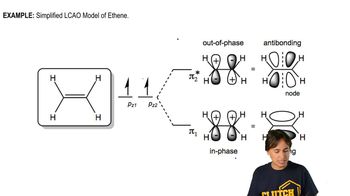
Molecular orbitals are formed by the linear combination of atomic orbitals (LCAO) and describe the behavior of electrons in a molecule. In the context of cyclopentadienyl ions, understanding how to construct bonding and antibonding MOs is crucial for predicting the stability and reactivity of these ions. The all-bonding MO represents a state where electrons are shared between atoms, while degenerate MOs indicate energy levels that are equal and can accommodate electrons in pairs.
Recommended video:
Guided course
08:41
Review of Molecular Orbitals

Degenerate Orbitals

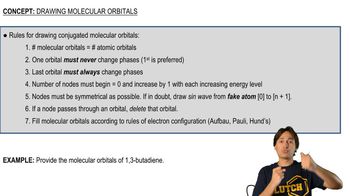
Degenerate orbitals are orbitals that have the same energy level. In the case of cyclopentadienyl ions, the presence of symmetry allows for the formation of degenerate MOs, which can hold two electrons each. Recognizing these orbitals is essential for accurately filling the MOs with electrons according to the Pauli exclusion principle and Hund's rule, which govern electron configuration in multi-electron systems.
Recommended video:
Guided course
03:44
The 7 Rules of Drawing Molecular Orbitals

Electronic Configuration

Electronic configuration refers to the distribution of electrons in the molecular orbitals of an ion or molecule. For cyclopentadienyl cations and anions, the electronic configuration will differ based on the addition or removal of electrons. Understanding how to fill the MOs and represent the resulting configurations is key to predicting the chemical properties and stability of these ions, as well as their reactivity in organic reactions.
Recommended video:
Guided course
02:14
The Electron Configuration
Related Practice
Textbook Question

Drawpictorialrepresentations (as in Figures16-4 and 16-6) for the three bonding MOs and the two nonbonding MOs of cyclooctatetraene. The antibonding MOs are difficult to draw, except for the all-antibonding MO.

4
views

Textbook Question

Explain why each compound or ion should be aromatic, antiaromatic, or nonaromatic.

(d)

(e)

(f) the [20]annulene dication

3
views
Textbook Question

The following hydrocarbon has an unusually large dipole moment. Explain how a large dipole moment might arise.

1
views
Textbook Question

(a) Draw the molecular orbitals for the cyclopropenyl case.

(Because there are three p orbitals, there must be three MOs: one all-bonding MO and one degenerate pair of MOs.)

(b) Draw an energy diagram for the cyclopropenyl MOs. (The polygon rule is helpful.) Label each MO as bonding, nonbonding, or antibonding, and add the nonbonding line. Notice that it goes through the approximate average of the MOs.

(c) Add electrons to your energy diagram to show the configuration of the cyclopropenyl cation and the cyclopropenyl anion. Which is aromatic and which is antiaromatic?

Textbook Question

a. Use the polygon rule to draw an energy diagram (as in Figures 16-5 and 16-7) for the MOs of a planar cyclooctatetraenyl system.

b. Fill in the eight pi electrons for cyclooctatetraene. Is this electronic configuration aromatic or antiaromatic? Could the cyclooctatetraene system be aromatic if it gained or lost electrons?

2
views
Textbook Question

Explain why each compound or ion should be aromatic, antiaromatic, or nonaromatic.

(a)

(b)

(c)

2
views