
Textbook Question
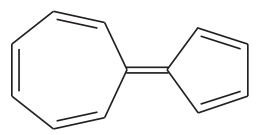
Explain why each compound or ion should be aromatic, antiaromatic, or nonaromatic.
(d)
(e)
(f) the [20]annulene dication
3
views

 Verified step by step guidance
Explain why each compound or ion should be aromatic, antiaromatic, or nonaromatic.
(d)
(e)
(f) the [20]annulene dication
When 3-chlorocyclopropene is treated with AgBF4, AgCl precipitates. The organic product can be obtained as a crystalline material, soluble in polar solvents such as nitromethane but insoluble in hexane. When the crystalline material is dissolved in nitromethane containing KCl, the original 3-chlorocyclopropene is regenerated. Determine the structure of the crystalline material, and write equations for its formation and its reaction with chloride ion.
a. Explain how pyrrole is isoelectronic with the cyclopentadienyl anion.
b. Specifically, what is the difference between the cyclopentadienyl anion and pyrrole?
The polarization of a carbonyl group can be represented by a pair of resonance structures:
Cyclopropenone and cycloheptatrienone are more stable than anticipated. Cyclopentadienone, however, is relatively unstable and rapidly undergoes a Diels–Alder dimerization. Explain.
Repeat Problem 16-10 for the cyclopentadienyl ions. Draw one all-bonding MO, then a pair of degenerate MOs, and then a final pair of degenerate MOs. Draw the energy diagram, fill in the electrons, and confirm the electronic configurations of the cyclopentadienyl cation and anion.
Explain why each compound or ion should be aromatic, antiaromatic, or nonaromatic.
(a)
(b)
(c)