Ch.11 - Reactions of Alcohols
Wade - Organic Chemistry 9th Edition
Wade9th EditionOrganic ChemistryISBN: 9780135213728Not the one you use?Change textbook
Chapter 11, Problem 42d

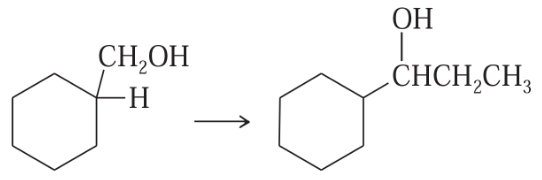
Show how you would accomplish the following synthetic conversions.
(d)

Verified step by step guidance
1
Step 1: Analyze the starting material and the product. The starting material is cyclohexylmethanol (cyclohexane ring with a CH2OH group attached). The product is cyclohexane with a secondary alcohol group (-OH) attached to a CHCH2CH3 group. This indicates that the reaction involves the formation of a new carbon-carbon bond and the conversion of the primary alcohol to a secondary alcohol.
Step 2: Perform a substitution reaction to introduce the CHCH2CH3 group. Use a strong base (e.g., NaH) to deprotonate the alcohol group, forming an alkoxide ion. Then, react the alkoxide with an alkyl halide such as 1-bromopropane (CH3CH2CH2Br) to form the desired carbon-carbon bond via an SN2 mechanism.
Step 3: Oxidize the primary alcohol group to an aldehyde using a mild oxidizing agent such as PCC (pyridinium chlorochromate). This step converts the CH2OH group into a CHO group.
Step 4: Perform a nucleophilic addition reaction to convert the aldehyde group into a secondary alcohol. Use a Grignard reagent such as ethylmagnesium bromide (CH3CH2MgBr) to add the ethyl group to the aldehyde, forming the secondary alcohol.
Step 5: Purify the product using standard organic chemistry techniques such as distillation or recrystallization to isolate the desired compound.

Verified video answer for a similar problem:

This video solution was recommended by our tutors as helpful for the problem above.
Video duration:
7m
Was this helpful?

Key Concepts

Here are the essential concepts you must grasp in order to answer the question correctly.

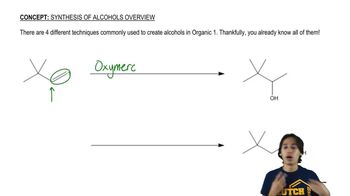
Synthesis of Alcohols

The conversion of alkenes or cyclic compounds to alcohols is a fundamental reaction in organic chemistry. This process often involves the addition of water (hydration) or the reduction of carbonyl compounds. Understanding the mechanisms of these reactions, including regioselectivity and stereochemistry, is crucial for predicting the outcome of synthetic pathways.
Recommended video:
Guided course
02:26
Forming alcohols through Oxymercuration-Reduction.

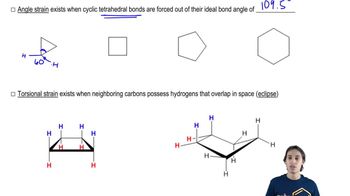
Ring Strain and Stability

Cycloalkanes, such as cyclohexane, can exhibit ring strain depending on their size and substituents. The stability of these rings influences their reactivity in synthetic transformations. In this case, the conversion involves a change in the ring structure, which may relieve strain and lead to more stable products, making it essential to consider when planning synthetic routes.
Recommended video:
Guided course
02:46
What is angle strain?

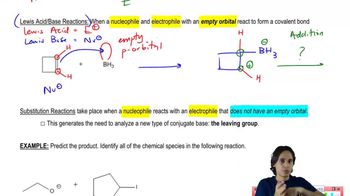
Nucleophilic Substitution Reactions

Nucleophilic substitution reactions are key in organic synthesis, where a nucleophile replaces a leaving group in a molecule. In the context of the provided reaction, understanding how nucleophiles interact with electrophilic centers is vital. This concept helps in predicting the formation of new bonds and the overall transformation of the starting material into the desired product.
Recommended video:
Guided course
01:47
Nucleophiles and Electrophiles can react in Substitution Reactions.