Ch.11 - Reactions of Alcohols
Wade - Organic Chemistry 9th Edition
Wade9th EditionOrganic ChemistryISBN: 9780135213728Not the one you use?Change textbook
Chapter 11, Problem 42c

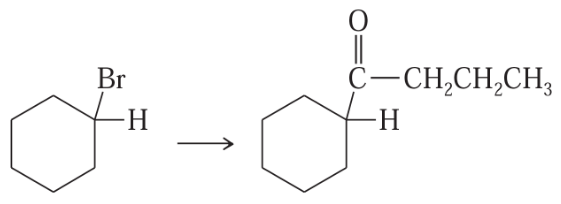
Show how you would accomplish the following synthetic conversions.
(c)

Verified step by step guidance
1
Step 1: Analyze the starting material and product. The starting material is cyclohexyl bromide, and the product is cyclohexyl propanone. This indicates that the bromine atom needs to be replaced with a propanone group.
Step 2: Perform a nucleophilic substitution reaction. Use a nucleophile such as cyanide ion (CN⁻) to replace the bromine atom with a cyano group (-CN). This reaction is typically carried out using sodium cyanide (NaCN) in a polar aprotic solvent like DMSO.
Step 3: Hydrolyze the cyano group to a carboxylic acid. Treat the intermediate cyclohexyl cyanide with acidic or basic hydrolysis conditions (e.g., H₃O⁺ or NaOH followed by acid workup) to convert the -CN group into a carboxylic acid (-COOH).
Step 4: Perform a decarboxylation reaction. React the carboxylic acid with propyl magnesium bromide (C₃H₇MgBr), a Grignard reagent, to form the ketone group. This step involves nucleophilic addition of the Grignard reagent to the carboxylic acid, followed by elimination of water.
Step 5: Purify the product. After the reaction is complete, isolate and purify cyclohexyl propanone using techniques such as distillation or recrystallization.

Verified video answer for a similar problem:

This video solution was recommended by our tutors as helpful for the problem above.
Video duration:
8m
Was this helpful?

Key Concepts

Here are the essential concepts you must grasp in order to answer the question correctly.

Nucleophilic Substitution

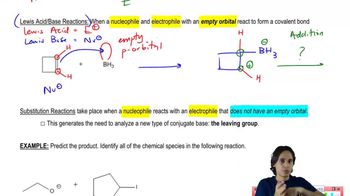
Nucleophilic substitution is a fundamental reaction in organic chemistry where a nucleophile attacks an electrophilic carbon atom, replacing a leaving group. In this case, the bromine atom (Br) on the cyclohexane ring acts as a leaving group, allowing a nucleophile to take its place. Understanding this mechanism is crucial for predicting the products of the reaction.
Recommended video:
Guided course
01:47
Nucleophiles and Electrophiles can react in Substitution Reactions.

Electrophilic Addition

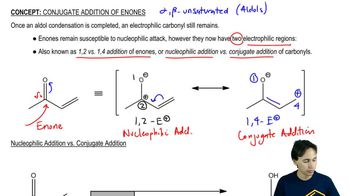
Electrophilic addition involves the reaction of an electrophile with a nucleophile, leading to the formation of a more complex molecule. In the context of the provided reaction, the carbonyl group (C=O) can act as an electrophile, facilitating the addition of a nucleophile to form a new carbon-carbon bond. This concept is essential for understanding how the structure of the product is formed from the starting materials.
Recommended video:
Guided course
09:23
1,2 vs 1,4 Addition

Functional Group Transformation

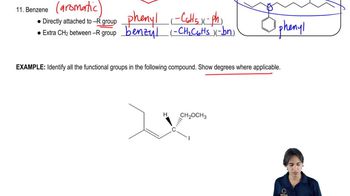
Functional group transformation refers to the process of converting one functional group into another through chemical reactions. In this case, the transformation involves converting a bromine substituent into a carbonyl group, which is a key step in synthesizing the desired product. Recognizing and manipulating functional groups is vital for successful organic synthesis.
Recommended video:
Guided course
02:36
Identifying Functional Groups