
Textbook Question
Show how you would make each compound, beginning with an alcohol of your choice.
(d)
(e)
(f)
1
views

 Verified step by step guidance
 1:21
1:21
 02:36
02:36 02:16
02:16Show how you would make each compound, beginning with an alcohol of your choice.
(d)
(e)
(f)
Show how you would convert (S)-hexan-2-ol to
(a) (S)-2-chlorohexane.
(b) (R)-2-bromohexane.
(c) (R)-hexan-2-ol.
Both cis- and trans-2-methylcyclohexanol undergo dehydration in warm sulfuric acid to give 1-methylcyclohexene as the major alkene product. These alcohols can also be converted to alkenes by tosylation using TsCl and pyridine, followed by elimination using KOC(CH3)3 as a strong base. Under these basic conditions, the tosylate of cis-2-methylcyclohexanol eliminates to give mostly 1-methylcyclohexene, but the tosylate of trans-2-methylcyclohexanol eliminates to give only 3-methylcyclohexene. Explain how this stereochemical difference in reactants controls a regiochemical difference in the products of the basic elimination, but not in the acid-catalyzed elimination.
Show how you would accomplish the following synthetic conversions.
(d)
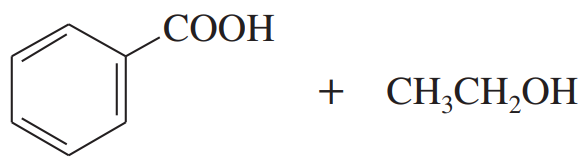
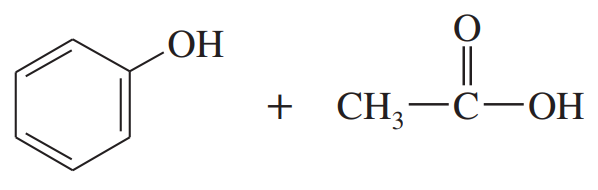
Predict the esterification products of the following acid/alcohol pairs.
(a) CH3CH2CH2COOH + CH3OH
(b) CH3OH + HNO3
(c) 2 CH3CH2OH + H3PO4
Predict the major products of dehydration catalyzed by sulfuric acid.
(a) hexan-1-ol
(b) hexan-2-ol
(c) pentan-3-ol