
Textbook Question
Ozonolysis of an unknown alkene A gives the products shown. Predict the product that results from hydrogenation of alkene A. [There are multiple answers, but only show the one with the 6-membered ring.]

 Verified step by step guidance
 05:11
05:11
 09:23
09:23 05:09
05:09Ozonolysis of an unknown alkene A gives the products shown. Predict the product that results from hydrogenation of alkene A. [There are multiple answers, but only show the one with the 6-membered ring.]
Consider the Cope rearrangement, a reaction we describe in Chapter 20.
(a) Using the knowledge we have gained here in Chapter 9, suggest a one-step, concerted mechanism that explains the formation of B from A.
(b) Which side of the reaction would you expect to be favored? Justify your answer.
(c) Which product, A or B, would you expect to be hydrogenated with the more exothermic heat of hydrogenation?
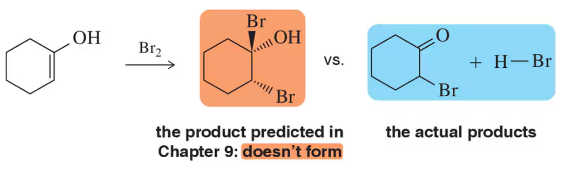
Bromination of a highly electron-rich alkene such as 2-methoxybut-2-ene has been shown to produce approximately equal mixtures of the trans- and cis-dibromide. Suggest an explanation for this observation.
In spite of being mechanistically similar to some of the reactions we saw in Chapter 8, rearrangement never occurred here in Chapter 9. Why doesn't rearrangement occur in the following bromination reaction despite the proximity of a more substituted carbon?
Predict the product of ozonolysis of the triglyceride shown.
Bromination of buta-1,3-diene with a single equivalent of Br2 can give either of two products. (a) Which of these products (A or B) would you predict to be more stable? Justify your answer.