
Ch. 9 - Alkenes II: Oxidation and Reduction
Mullins - Organic Chemistry: A Learner Centered Approach 1st Edition
Mullins1st EditionOrganic Chemistry: A Learner Centered ApproachISBN: 9780137566471Not the one you use?Change textbook
Chapter 8, Problem 51

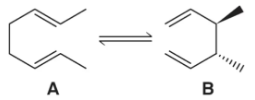
Consider the Cope rearrangement, a reaction we describe in Chapter 20.
(a) Using the knowledge we have gained here in Chapter 9, suggest a one-step, concerted mechanism that explains the formation of B from A.
(b) Which side of the reaction would you expect to be favored? Justify your answer.
(c) Which product, A or B, would you expect to be hydrogenated with the more exothermic heat of hydrogenation?

Verified step by step guidance
1
Step 1: Analyze the Cope rearrangement mechanism. The Cope rearrangement is a [3,3]-sigmatropic reaction, which involves the concerted movement of electrons. In this case, the reaction starts with compound A, where the π-electrons in the double bonds and the σ-electrons in the single bonds rearrange to form compound B. Draw the curved arrows to show the electron movement.
Step 2: Consider the thermodynamic stability of A and B to determine which side of the reaction is favored. Compound B introduces a stereogenic center and a conjugated diene system, which increases stability due to conjugation. Compare the stability of the conjugated diene in B versus the isolated double bonds in A.
Step 3: Evaluate the heat of hydrogenation for A and B. Hydrogenation is more exothermic for less stable compounds. Since A has isolated double bonds and lacks conjugation, it is less stable than B. Therefore, A would release more heat upon hydrogenation compared to B.
Step 4: Justify the favorability of the reaction direction. The formation of B is favored due to the increased stability from conjugation and the stereogenic center. This aligns with the principle that reactions tend to favor the formation of more stable products.
Step 5: Summarize the mechanism and thermodynamic considerations. The Cope rearrangement proceeds via a concerted mechanism, favoring the formation of B due to its conjugated diene system. A would exhibit a more exothermic heat of hydrogenation due to its lower stability.

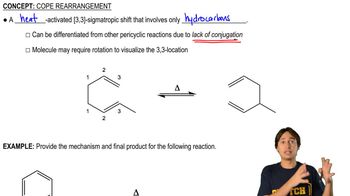
Verified video answer for a similar problem:

This video solution was recommended by our tutors as helpful for the problem above.
Was this helpful?

Key Concepts

Here are the essential concepts you must grasp in order to answer the question correctly.

Cope Rearrangement

The Cope rearrangement is a thermal rearrangement of 1,5-hexadienes that involves a concerted mechanism, resulting in the migration of substituents across a double bond. This reaction is characterized by the formation of a new sigma bond and the breaking of an existing sigma bond, all occurring in a single step without intermediates. Understanding this rearrangement is crucial for predicting the products formed from the starting materials in the question.
Recommended video:
Guided course
06:28
Definition of Cope Rearrangement

Concerted Mechanism

A concerted mechanism refers to a reaction pathway where bond breaking and bond forming occur simultaneously in a single step, without the formation of intermediates. This type of mechanism is essential in understanding the Cope rearrangement, as it allows for the prediction of product formation based on the alignment and overlap of orbitals during the transition state. Recognizing the concerted nature of the reaction helps in visualizing how the reactants transform into products.
Recommended video:
Guided course
04:32
General Mechanism

Heat of Hydrogenation

The heat of hydrogenation is the amount of energy released when a compound is hydrogenated, which can be used to assess the stability of alkenes. More stable alkenes have lower heats of hydrogenation because they are less reactive and require less energy to convert to alkanes. In the context of the question, comparing the heats of hydrogenation for products A and B will help determine which product is more stable and thus favored in the reaction.
Recommended video:
Guided course
00:48
The definition of hydrogenation.
Related Practice
Textbook Question

One way to think about concerted reactions is to imagine them as being stepwise reactions where, besides the slowest step, all others have infinitesimally small activation energies. Considering the hypothetical stepwise mechanism and actual concerted mechanism of epoxide formation, show what a reaction coordinate diagram might look like for each possibility.

(b) Concerted , actual mechanism (butterfly transition state:

1
views
Textbook Question

One way to think about concerted reactions is to imagine them as being stepwise reactions where, besides the slowest step, all others have infinitesimally small activation energies. Considering the hypothetical stepwise mechanism and actual concerted mechanism of epoxide formation, show what a reaction coordinate diagram might look like for each possibility.

(a) Stepwise, hypothetical mechanism:

1
views
Textbook Question

Bromination of a highly electron-rich alkene such as 2-methoxybut-2-ene has been shown to produce approximately equal mixtures of the trans- and cis-dibromide. Suggest an explanation for this observation.

7
views
Textbook Question

In Chapter 19, we discuss the reaction of enols with bromine. This reaction produces α -bromoketones in good yields. Suggest a mechanism for this reaction and justify its deviation from the dibromide product you might have expected.

1
views
Textbook Question

In light of your answer to Assessment 9.47, predict the product of the following reactions we have seen previously where an alcohol is substituted for water.

(c)

1
views
Textbook Question

Bromination of buta-1,3-diene with a single equivalent of Br2 can give either of two products. (a) Which of these products (A or B) would you predict to be more stable? Justify your answer.

6
views