
Ch. 9 - Alkenes II: Oxidation and Reduction
Mullins - Organic Chemistry: A Learner Centered Approach 1st Edition
Mullins1st EditionOrganic Chemistry: A Learner Centered ApproachISBN: 9780137566471Not the one you use?Change textbook
Chapter 8, Problem 53

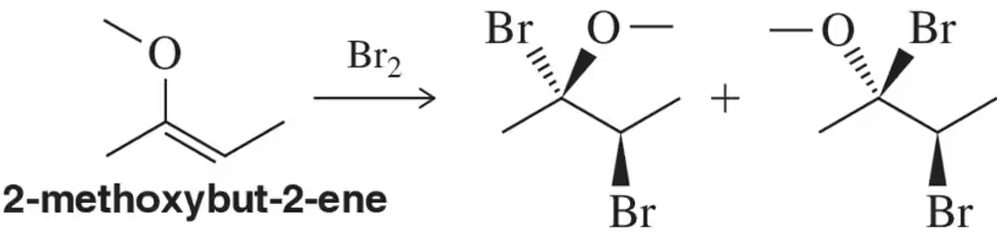
Bromination of a highly electron-rich alkene such as 2-methoxybut-2-ene has been shown to produce approximately equal mixtures of the trans- and cis-dibromide. Suggest an explanation for this observation.
Bromination reaction of 2-methoxybut-2-ene producing trans- and cis-dibromide products.

Verified step by step guidance
1
Understand the reaction: Bromination of alkenes involves the addition of bromine (Br₂) across the double bond. This reaction typically proceeds via a three-step mechanism involving the formation of a bromonium ion intermediate.
Analyze the substrate: 2-methoxybut-2-ene is an electron-rich alkene due to the presence of the methoxy (-OCH₃) group, which donates electron density to the double bond through resonance and inductive effects. This increases the reactivity of the alkene toward electrophilic addition reactions like bromination.
Examine the mechanism: The first step involves the attack of the alkene on Br₂, forming a cyclic bromonium ion intermediate. This intermediate is highly strained and positively charged, making it susceptible to nucleophilic attack by the bromide ion (Br⁻).
Consider stereochemical outcomes: The bromide ion can attack the bromonium ion from either the top face or the bottom face of the planar intermediate. This leads to the formation of both trans- and cis-dibromides. The electron-rich nature of the alkene may reduce the preference for anti-addition (which typically dominates in bromination), allowing for the formation of both stereoisomers in approximately equal amounts.
Conclude the explanation: The equal mixture of trans- and cis-dibromides arises because the electron-rich nature of the alkene destabilizes the bromonium ion, reducing the stereochemical control of the reaction and allowing for nucleophilic attack from both faces of the intermediate with similar probabilities.

Verified video answer for a similar problem:

This video solution was recommended by our tutors as helpful for the problem above.
Was this helpful?

Key Concepts

Here are the essential concepts you must grasp in order to answer the question correctly.

Electrophilic Addition Reactions

Electrophilic addition reactions involve the addition of an electrophile to a nucleophilic alkene. In the case of bromination, bromine acts as the electrophile, attacking the electron-rich double bond of the alkene. This reaction typically leads to the formation of a cyclic bromonium ion intermediate, which can then be attacked by a bromide ion from either side, resulting in different stereochemical outcomes.
Recommended video:
Guided course
05:39
Features of Addition Mechanisms.

Stereochemistry of Alkene Reactions

Stereochemistry refers to the spatial arrangement of atoms in molecules and how this affects their chemical behavior. In the bromination of alkenes, the formation of both cis and trans dibromides occurs due to the planar nature of the bromonium ion intermediate, allowing for attack from either side. This leads to the formation of both stereoisomers, resulting in a mixture of products.
Recommended video:
1:38
Polymer Stereochemistry Concept 1

Regioselectivity and Stereoselectivity

Regioselectivity and stereoselectivity are important concepts in organic reactions that describe how products are formed preferentially. In the bromination of 2-methoxybut-2-ene, the reaction is both regioselective and stereoselective, producing a mixture of cis and trans dibromides due to the symmetrical nature of the alkene and the lack of steric hindrance, allowing for equal formation of both isomers.
Recommended video:
Guided course
05:09
Heck Reaction
Related Practice
Textbook Question

One way to think about concerted reactions is to imagine them as being stepwise reactions where, besides the slowest step, all others have infinitesimally small activation energies. Considering the hypothetical stepwise mechanism and actual concerted mechanism of epoxide formation, show what a reaction coordinate diagram might look like for each possibility.

(b) Concerted , actual mechanism (butterfly transition state:

1
views
Textbook Question

Ozonolysis of an unknown alkene A gives the products shown. Predict the product that results from hydrogenation of alkene A. [There are multiple answers, but only show the one with the 6-membered ring.]

Textbook Question

Consider the Cope rearrangement, a reaction we describe in Chapter 20.

(a) Using the knowledge we have gained here in Chapter 9, suggest a one-step, concerted mechanism that explains the formation of B from A.

(b) Which side of the reaction would you expect to be favored? Justify your answer.

(c) Which product, A or B, would you expect to be hydrogenated with the more exothermic heat of hydrogenation?

2
views
Textbook Question

In Chapter 19, we discuss the reaction of enols with bromine. This reaction produces α -bromoketones in good yields. Suggest a mechanism for this reaction and justify its deviation from the dibromide product you might have expected.

1
views
Textbook Question

Predict the product of ozonolysis of the triglyceride shown.

Textbook Question

Bromination of buta-1,3-diene with a single equivalent of Br2 can give either of two products. (a) Which of these products (A or B) would you predict to be more stable? Justify your answer.

6
views