Ch. 9 - Alkenes II: Oxidation and Reduction
Mullins - Organic Chemistry: A Learner Centered Approach 1st Edition
Mullins1st EditionOrganic Chemistry: A Learner Centered ApproachISBN: 9780137566471Not the one you use?Change textbook
Chapter 8, Problem 35

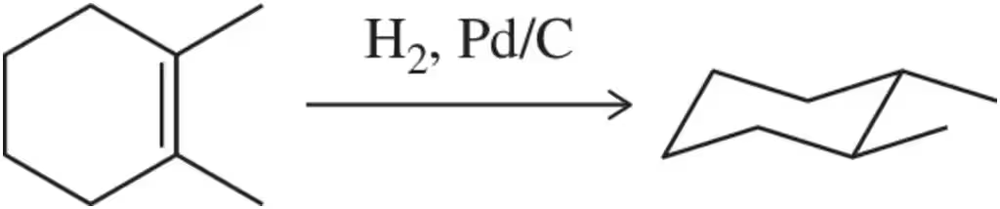
A misguided chemist attempted to synthesize trans-1,2-dimethylcyclohexane via the hydrogenation of 1,2-dimethylcyclohexene. Explain why this is not possible.
Chemical reaction diagram showing hydrogenation of 1,2-dimethylcyclohexene to trans-1,2-dimethylcyclohexane, which is not possible.

Verified step by step guidance
1
Understand the structure of 1,2-dimethylcyclohexene: It is a cyclohexene ring with two methyl groups attached at the 1 and 2 positions. The double bond is between these two carbon atoms.
Recognize the stereochemistry involved: The term 'trans' refers to the configuration where substituents are on opposite sides of the cyclohexane ring. In cyclohexenes, the double bond restricts rotation, so the initial configuration of substituents is crucial.
Consider the process of hydrogenation: Hydrogenation involves adding hydrogen (H₂) across the double bond, converting it into a single bond. This process typically occurs on the same side of the molecule, leading to a 'cis' configuration.
Analyze the stereochemical outcome: During hydrogenation, the addition of hydrogen atoms to the double bond in 1,2-dimethylcyclohexene will result in both methyl groups being on the same side of the ring, forming cis-1,2-dimethylcyclohexane.
Conclude why trans-1,2-dimethylcyclohexane cannot be synthesized this way: The hydrogenation process does not allow for the formation of a trans configuration due to the syn addition mechanism, which inherently leads to a cis product.

Verified video answer for a similar problem:

This video solution was recommended by our tutors as helpful for the problem above.
Video duration:
3m
Was this helpful?

Key Concepts

Here are the essential concepts you must grasp in order to answer the question correctly.

Stereochemistry of Cyclohexane

Cyclohexane can exist in different conformations, such as chair and boat, which affect the spatial arrangement of substituents. In the chair conformation, substituents can be axial or equatorial, influencing their interactions and stability. Understanding these conformations is crucial for predicting the stereochemistry of reactions involving cyclohexane derivatives.
Recommended video:
1:38
Polymer Stereochemistry Concept 1

Hydrogenation Reaction Mechanism

Hydrogenation involves the addition of hydrogen (H2) across a double bond, typically using a metal catalyst like palladium or platinum. This reaction converts alkenes to alkanes, but it does not alter the stereochemistry of the substituents on the carbon atoms involved. Therefore, the stereochemistry of the starting alkene dictates the stereochemistry of the product.
Recommended video:
3:55
Triacylglycerol Reactions: Hydrogenation Concept 1

Cis-Trans Isomerism

Cis-trans isomerism refers to the arrangement of substituents around a double bond or a ring structure. In cyclohexene derivatives, the cis configuration has substituents on the same side, while trans has them on opposite sides. Hydrogenation of 1,2-dimethylcyclohexene, which is cis, cannot yield trans-1,2-dimethylcyclohexane due to the preservation of stereochemistry during the reaction.
Recommended video:
Guided course
00:44
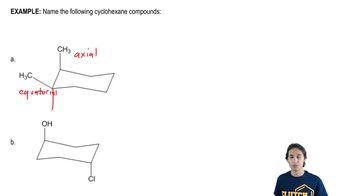
Is the following cyclohexane cis or trans?
Related Practice
Textbook Question

Without concerning yourself with the mechanism of the reaction, calculate the equilibrium constant for the following equilibrium processes. (Assume T = 298 K.)

(a)

1
views

Textbook Question

Formation of the molozonide can be expected to proceed stereospecifically. Why is this the case? Show the two different molozonides you would expect to get from ozonolysis of (E)- and (Z)-3,4-dimethylhept-3-ene.


2
views
Textbook Question

Because deuterium behaves like hydrogen in chemical reactions yet is detected differently, chemists use the incorporation of deuterium to better understand the subtleties of reaction mechanisms. Deuterium is incorporated by replacing H₂ with D₂ in the hydrogenation reaction. Identify the product expected when the alkenes in Assessment 9.34 react with D₂ and Pd/C. [Don't worry about showing all diastereomers.]

1
views
Textbook Question

What product results when the following molecules are treated with H₂ Pd/C? Be sure to indicate the relative stereochemical outcome. Draw both enantiomers of any racemic mixtures. [It is difficult to control the stoichiometry of gases so there is enough H₂ to reduce all alkenes.]

(b)

1
views
Textbook Question

In Solved Assessment 9.30(b), we came up with an alkene that under the conditions of ozonolysis would produce acetophenone and acetaldehyde. There is one other alkene that should produce the same compounds under these conditions. Which is it?

Textbook Question

Conjugated dienes, molecules containing two alkenes separated by one single bond, are discussed in detail in Chapter 21.

(a) Considering the observed ∆H° of hydrogenation, is hexa-1,3-diene (conjugated) or hexa-1,4-diene (unconjugated) more stable?

1
views