
Textbook Question
A misguided chemist attempted to synthesize trans-1,2-dimethylcyclohexane via the hydrogenation of 1,2-dimethylcyclohexene. Explain why this is not possible.
1
views


 Verified step by step guidance
 06:30
06:30
 15:39
15:39 03:48
03:48A misguided chemist attempted to synthesize trans-1,2-dimethylcyclohexane via the hydrogenation of 1,2-dimethylcyclohexene. Explain why this is not possible.
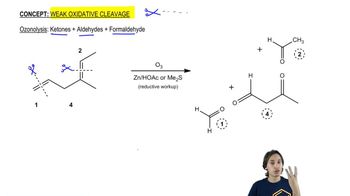
Suggest a synthesis of the following aldehydes or ketones using the ozonolysis reaction of an alkene.
(b)
Suggest a synthesis of the following aldehydes or ketones using the ozonolysis reaction of an alkene.
(a)
Because deuterium behaves like hydrogen in chemical reactions yet is detected differently, chemists use the incorporation of deuterium to better understand the subtleties of reaction mechanisms. Deuterium is incorporated by replacing H₂ with D₂ in the hydrogenation reaction. Identify the product expected when the alkenes in Assessment 9.34 react with D₂ and Pd/C. [Don't worry about showing all diastereomers.]
What product results when the following molecules are treated with H₂ Pd/C? Be sure to indicate the relative stereochemical outcome. Draw both enantiomers of any racemic mixtures. [It is difficult to control the stoichiometry of gases so there is enough H₂ to reduce all alkenes.]
(b)
In Solved Assessment 9.30(b), we came up with an alkene that under the conditions of ozonolysis would produce acetophenone and acetaldehyde. There is one other alkene that should produce the same compounds under these conditions. Which is it?