Ch. 9 - Alkenes II: Oxidation and Reduction
Mullins - Organic Chemistry: A Learner Centered Approach 1st Edition
Mullins1st EditionOrganic Chemistry: A Learner Centered ApproachISBN: 9780137566471Not the one you use?Change textbook
Chapter 8, Problem 37a

Without concerning yourself with the mechanism of the reaction, calculate the equilibrium constant for the following equilibrium processes. (Assume T = 298 K.)
(a) Chemical structure representation showing a reversible reaction between two organic compounds.

Verified step by step guidance
1
Step 1: Identify the relationship between the equilibrium constant (K) and the Gibbs free energy change (ΔG°) using the equation ΔG° = -RT ln(K), where R is the gas constant (8.314 J/mol·K) and T is the temperature in Kelvin (298 K).
Step 2: Determine the value of ΔG° for the given equilibrium process. If ΔG° is not provided, it may need to be calculated or derived from other thermodynamic data such as enthalpy (ΔH°) and entropy (ΔS°) using the equation ΔG° = ΔH° - TΔS°.
Step 3: Rearrange the equation ΔG° = -RT ln(K) to solve for K. This gives ln(K) = -ΔG° / (RT).
Step 4: Substitute the known values of ΔG°, R, and T into the equation ln(K) = -ΔG° / (RT) to calculate ln(K).
Step 5: Exponentiate both sides of the equation to solve for K, using K = e^(ln(K)). This will yield the equilibrium constant for the reaction.

Verified video answer for a similar problem:

This video solution was recommended by our tutors as helpful for the problem above.
Video duration:
9m
Was this helpful?

Key Concepts

Here are the essential concepts you must grasp in order to answer the question correctly.

Equilibrium Constant (K)

The equilibrium constant (K) is a numerical value that expresses the ratio of the concentrations of products to reactants at equilibrium for a given chemical reaction. It is temperature-dependent and provides insight into the extent of a reaction; a large K indicates a reaction that favors products, while a small K suggests a preference for reactants.
Recommended video:
Guided course
02:19
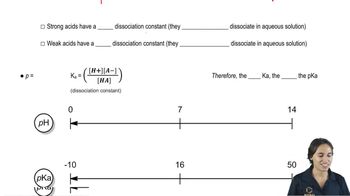
The relationship between equilibrium constant and pKa.

Le Chatelier's Principle

Le Chatelier's Principle states that if a dynamic equilibrium is disturbed by changing the conditions, the system will adjust itself to counteract the change and restore a new equilibrium. This principle helps predict how changes in concentration, pressure, or temperature will affect the position of equilibrium in a reaction.
Recommended video:
Guided course
04:12
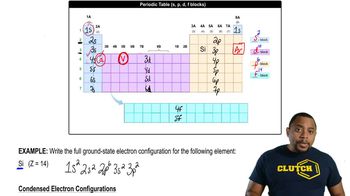
The Electron Configuration

Standard Conditions

Standard conditions refer to a set of specific conditions (usually 1 atm pressure and 298 K temperature) under which thermodynamic measurements are made. These conditions provide a consistent basis for comparing the equilibrium constants of different reactions, ensuring that variations in temperature or pressure do not affect the calculated values.
Recommended video:
Guided course
09:36
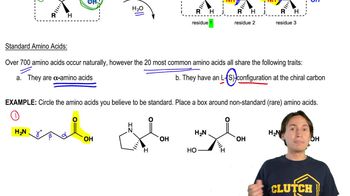
Standard Amino Acids
Related Practice
Textbook Question

A misguided chemist attempted to synthesize trans-1,2-dimethylcyclohexane via the hydrogenation of 1,2-dimethylcyclohexene. Explain why this is not possible.

1
views

Textbook Question

Conjugated dienes, molecules containing two alkenes separated by one single bond, are discussed in detail in Chapter 21.

(b) How might you account for this difference in stability?

2
views
Textbook Question

Questions (a)–(d) all refer to the following reaction, which has been engineered to produce one enantiomer to the exclusion of the other.

(c) Suppose the difference in activation energy is 1.6 kcal/mol. At what temperature would you produce C in 99% ee?

2
views
Textbook Question

Because deuterium behaves like hydrogen in chemical reactions yet is detected differently, chemists use the incorporation of deuterium to better understand the subtleties of reaction mechanisms. Deuterium is incorporated by replacing H₂ with D₂ in the hydrogenation reaction. Identify the product expected when the alkenes in Assessment 9.34 react with D₂ and Pd/C. [Don't worry about showing all diastereomers.]

1
views
Textbook Question

What product results when the following molecules are treated with H₂ Pd/C? Be sure to indicate the relative stereochemical outcome. Draw both enantiomers of any racemic mixtures. [It is difficult to control the stoichiometry of gases so there is enough H₂ to reduce all alkenes.]

(b)

1
views
Textbook Question

Conjugated dienes, molecules containing two alkenes separated by one single bond, are discussed in detail in Chapter 21.

(a) Considering the observed ∆H° of hydrogenation, is hexa-1,3-diene (conjugated) or hexa-1,4-diene (unconjugated) more stable?

1
views