Ch. 8 - Alkenes I: Properties and Electrophilic Additions
Mullins - Organic Chemistry: A Learner Centered Approach 1st Edition
Mullins1st EditionOrganic Chemistry: A Learner Centered ApproachISBN: 9780137566471Not the one you use?Change textbook
Chapter 7, Problem 25

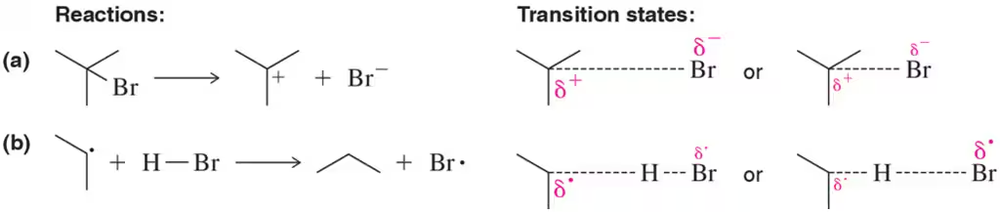
Which is the most likely transition state for the reactions shown? Explain your answer. [Note the difference in the size of the partial charges or partial unpaired electrons.]
Image showing two reactions with corresponding transition states, highlighting partial charges and unpaired electrons.

Verified step by step guidance
1
Begin by understanding the concept of a transition state in a chemical reaction. A transition state is a high-energy, unstable arrangement of atoms that occurs during the transformation from reactants to products. It represents the point of maximum energy along the reaction path.
Examine the given reaction and identify the reactants and products. Consider the changes in bonding and electron distribution that occur during the reaction. This will help you visualize the transition state.
Consider the role of partial charges and partial unpaired electrons in the transition state. These factors can influence the stability and energy of the transition state. Larger partial charges or unpaired electrons can indicate areas of high reactivity or instability.
Analyze the molecular structure of the reactants and products to predict the most likely transition state. Look for changes in bond lengths, angles, and electron distribution that would occur as the reactants transform into products.
Compare the possible transition states based on their energy and stability. The most likely transition state is typically the one with the lowest energy barrier, which can be influenced by factors such as steric hindrance, electronic effects, and the presence of catalysts.

Verified video answer for a similar problem:

This video solution was recommended by our tutors as helpful for the problem above.
Video duration:
3m
Was this helpful?

Key Concepts

Here are the essential concepts you must grasp in order to answer the question correctly.

Transition State Theory

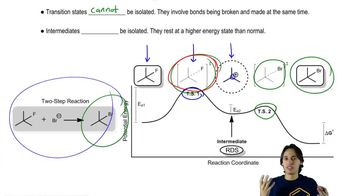
Transition state theory describes the high-energy state that occurs during a chemical reaction, where reactants are transformed into products. It is a transient configuration that represents the maximum energy point along the reaction path. Understanding the transition state is crucial for predicting reaction rates and mechanisms, as it provides insight into the energy barrier that must be overcome for the reaction to proceed.
Recommended video:
Guided course
06:55
Intermediates vs. Transition States

Partial Charges and Electronegativity

Partial charges arise due to differences in electronegativity between atoms in a molecule, leading to an uneven distribution of electron density. Atoms with higher electronegativity attract electrons more strongly, resulting in a partial negative charge, while less electronegative atoms acquire a partial positive charge. Recognizing these charges is essential for predicting molecular interactions and the stability of transition states.
Recommended video:
Guided course
1:47
Electronegativity

Unpaired Electrons and Radical Stability

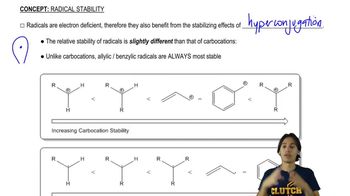
Unpaired electrons are electrons that are not paired with another electron in an orbital, often found in radicals. The stability of radicals is influenced by factors such as resonance, hyperconjugation, and the nature of the substituents. Understanding the distribution and stability of unpaired electrons is vital for determining the most likely transition state, as it affects the energy and feasibility of the reaction pathway.
Recommended video:
Guided course
03:43
The radical stability trend.