Ch. 8 - Alkenes I: Properties and Electrophilic Additions
Mullins - Organic Chemistry: A Learner Centered Approach 1st Edition
Mullins1st EditionOrganic Chemistry: A Learner Centered ApproachISBN: 9780137566471Not the one you use?Change textbook
Chapter 7, Problem 23

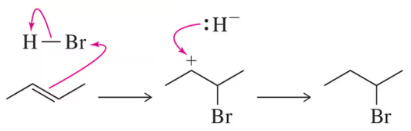
A wayward chemist proposed the following mechanism for the addition of HBr to an alkene.

(a) Why is this mechanism unlikely?
(b) Compare the reaction coordinate diagrams for the actual mechanism studied in Section 8.3.1 and this alternate mechanism on the same graph.

Verified step by step guidance
1
Identify the proposed mechanism: The image shows a two-step mechanism where the alkene first reacts with HBr to form a carbocation intermediate, followed by the attack of a hydride ion (H-) on the carbocation.
Explain why the mechanism is unlikely: In typical electrophilic addition reactions of alkenes with HBr, the alkene acts as a nucleophile and attacks the proton (H+) from HBr, forming a carbocation. The bromide ion (Br-) then attacks the carbocation. The presence of a hydride ion (H-) as a nucleophile is highly unusual and unlikely under normal conditions.
Discuss the stability of intermediates: Carbocations are generally stabilized by hyperconjugation and inductive effects. The proposed mechanism suggests a hydride ion attacking a carbocation, which is not a common or favorable reaction pathway.
Compare with the actual mechanism: In the actual mechanism, the alkene first forms a carbocation by protonation, and then the bromide ion attacks the carbocation to form the final product. This is a more straightforward and energetically favorable pathway.
Sketch the reaction coordinate diagram: For the actual mechanism, the diagram would show an initial energy increase to form the carbocation, followed by a decrease as the bromide ion attacks. The proposed mechanism would have an additional energy barrier for the unlikely hydride attack, making it less favorable overall.

Verified video answer for a similar problem:

This video solution was recommended by our tutors as helpful for the problem above.
Video duration:
7m
Was this helpful?

Key Concepts

Here are the essential concepts you must grasp in order to answer the question correctly.

Electrophilic Addition Mechanism

The electrophilic addition mechanism is a fundamental reaction pathway for alkenes, where an electrophile (like HBr) attacks the electron-rich double bond of the alkene. This process typically involves the formation of a carbocation intermediate, which is then attacked by a nucleophile. Understanding this mechanism is crucial for analyzing the proposed mechanism and identifying its flaws.
Recommended video:
Guided course
05:39
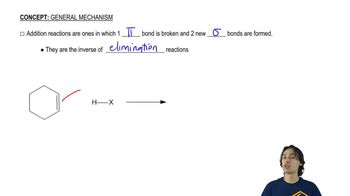
Features of Addition Mechanisms.

Carbocation Stability

Carbocation stability is a key concept in organic chemistry, as the stability of the carbocation intermediate significantly influences the reaction pathway. Carbocations can be classified as primary, secondary, or tertiary, with tertiary carbocations being the most stable due to hyperconjugation and inductive effects. Evaluating the stability of the proposed carbocation in the mechanism helps determine the likelihood of the reaction occurring as suggested.
Recommended video:
Guided course
05:58
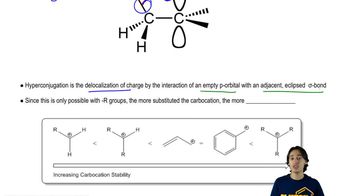
Determining Carbocation Stability

Reaction Coordinate Diagrams

Reaction coordinate diagrams visually represent the energy changes during a chemical reaction, illustrating the transition states and intermediates involved. These diagrams allow for a comparison of different mechanisms by showing the energy barriers and the relative stability of intermediates. Analyzing the reaction coordinate diagrams for both the proposed and actual mechanisms will highlight differences in energy profiles and support conclusions about their feasibility.
Recommended video:
Guided course
05:02
Coordination Complexes