
For each of the products you predicted in Assessment 8.39, provide an arrow-pushing mechanism which rationalizes the formation of each product. Make sure your mechanism accounts for all products formed, including stereoisomers and regioisomers, where applicable.

When combining isoprene equivalents, IPP is never the electrophile. Why might this be? What is special about DPP that allows it to function better as an electrophile? [Draw the carbocation that each becomes.]
Verified step by step guidance
Verified video answer for a similar problem:
Key Concepts
Isoprene Units and Their Role in Organic Chemistry
Electrophiles and Nucleophiles
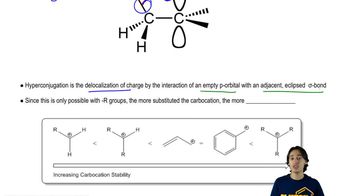
Carbocation Stability
Ethers can be synthesized by substituting ethanol for water in the acid-catalyzed hydration reaction. Suggest an arrow-pushing mechanism which accounts for the formation of the ethyl ether under these conditions.
Which of the following carbocations would you expect to rearrange? If you expect rearrangement, draw the carbocation you expect to form and the mechanism by which it will form.
(a)
Suggest a mechanism for the synthesis of farnesol beginning with IPP and DPP.
Provide the alkene that would give the following alcohols under acid-catalyzed hydration conditions.
(a)
Which of the following carbocations would you expect to rearrange? If you expect rearrangement, draw the carbocation you expect to form and the mechanism by which it will form.
(b)
