When combining isoprene equivalents, IPP is never the electrophile. Why might this be? What is special about DPP that allows it to function better as an electrophile? [Draw the carbocation that each becomes.]
Ch. 8 - Alkenes I: Properties and Electrophilic Additions

Mullins1st EditionOrganic Chemistry: A Learner Centered ApproachISBN: 9780137566471Not the one you use?Change textbook
Chapter 7, Problem 42
Ethers can be synthesized by substituting ethanol for water in the acid-catalyzed hydration reaction. Suggest an arrow-pushing mechanism which accounts for the formation of the ethyl ether under these conditions.

Verified step by step guidance1
Start by identifying the reactants involved in the acid-catalyzed hydration reaction. In this case, ethanol (C₂H₅OH) is used instead of water, and an acid catalyst, such as sulfuric acid (H₂SO₄), is present.
The first step in the mechanism involves the protonation of the ethanol molecule by the acid catalyst. This is represented by an arrow showing the movement of electrons from the lone pair on the oxygen atom of ethanol to the hydrogen ion (H⁺) from the acid, forming an oxonium ion (C₂H₅OH₂⁺).
Next, another ethanol molecule acts as a nucleophile and attacks the positively charged carbon atom of the oxonium ion. This is shown by an arrow from the lone pair on the oxygen of the second ethanol molecule to the carbon atom of the oxonium ion, leading to the formation of a new C-O bond.
Following the nucleophilic attack, the oxonium ion undergoes deprotonation. An arrow is drawn from the bond between the oxygen and hydrogen in the oxonium ion to the oxygen atom, resulting in the removal of a proton and the formation of ethyl ether (C₂H₅OC₂H₅) and a water molecule.
Finally, regenerate the acid catalyst by showing the removal of a proton from the water molecule formed in the previous step, which restores the acid catalyst to its original state, completing the catalytic cycle.

Verified video answer for a similar problem:
This video solution was recommended by our tutors as helpful for the problem above.
Video duration:
3mWas this helpful?
Key Concepts
Here are the essential concepts you must grasp in order to answer the question correctly.
Acid-Catalyzed Hydration
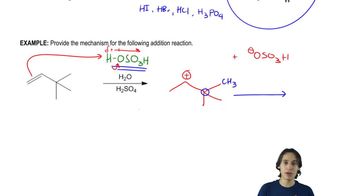
Acid-catalyzed hydration is a reaction where an alkene reacts with water in the presence of an acid to form an alcohol. The acid acts as a catalyst, protonating the alkene to form a carbocation intermediate, which then reacts with water to yield the alcohol. Understanding this mechanism is crucial as it forms the basis for modifying the reaction to synthesize ethers.
Recommended video:
Guided course
Acid-catalyzed hydration mechanism
Carbocation Intermediate
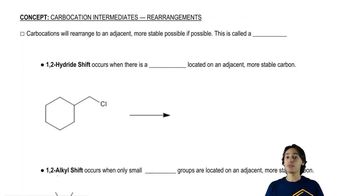
A carbocation is a positively charged carbon atom that is an intermediate in many organic reactions, including acid-catalyzed hydration. Its stability is influenced by the surrounding substituents, with more substituted carbocations being more stable. Recognizing the formation and stability of carbocations is essential for predicting reaction pathways and outcomes in ether synthesis.
Recommended video:
Guided course
Understanding why carbocations shift.
Nucleophilic Substitution
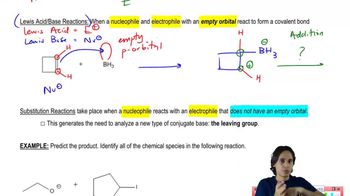
Nucleophilic substitution involves the replacement of a leaving group by a nucleophile. In the context of ether synthesis, ethanol acts as the nucleophile, attacking the carbocation intermediate to form an ether. Understanding this concept helps in visualizing how the substitution of water with ethanol leads to the formation of ethyl ether in the reaction mechanism.
Recommended video:
Guided course
Nucleophiles and Electrophiles can react in Substitution Reactions.
Related Practice
Textbook Question
5
views
Textbook Question
For each of the products you predicted in Assessment 8.39, provide an arrow-pushing mechanism which rationalizes the formation of each product. Make sure your mechanism accounts for all products formed, including stereoisomers and regioisomers, where applicable.
2
views
Textbook Question
Which of the following carbocations would you expect to rearrange? If you expect rearrangement, draw the carbocation you expect to form and the mechanism by which it will form.
(a)
3
views
Textbook Question
Provide the expected product for the reaction of each of the following alkenes with H2SO4 and H2O.
(d)
2
views
Textbook Question
Suggest a mechanism for the synthesis of farnesol beginning with IPP and DPP.
1
views
Textbook Question
Provide the alkene that would give the following alcohols under acid-catalyzed hydration conditions.
(a)
1
views