Ch. 6 - Stereoisomerism: Arrangement of Atoms in Space
Mullins - Organic Chemistry: A Learner Centered Approach 1st Edition
Mullins1st EditionOrganic Chemistry: A Learner Centered ApproachISBN: 9780137566471Not the one you use?Change textbook
Chapter 5, Problem 27b,c,d

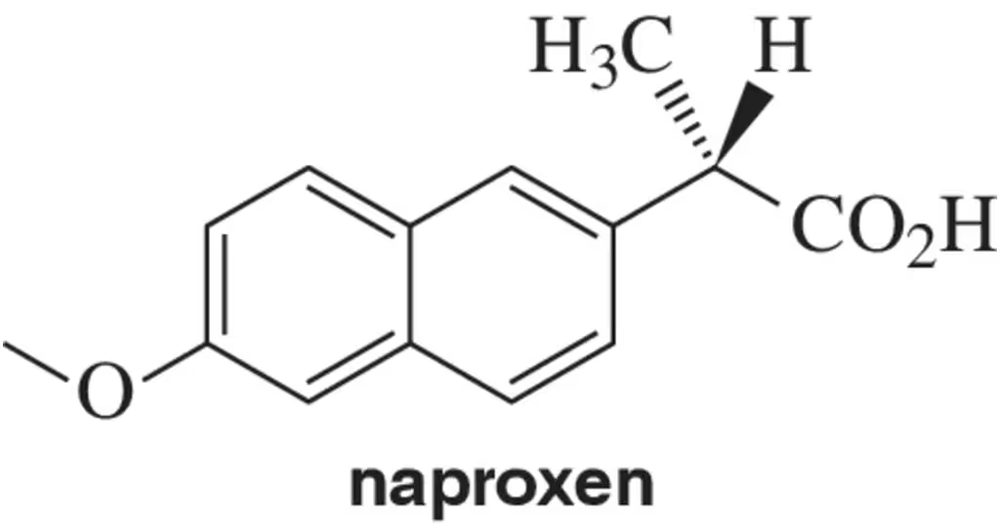
Naproxen is a commercially available anti-inflammatory sold under the name Aleve.
(b) Given that naproxen rotates plane-polarized light in the clockwise direction, should it be referred to as (d) or (l)?
(c) Is it (+) or (-)?
(d) What direction (d or l; + or −) would you expect the enantiomer of naproxen to rotate plane-polarized light?
Chemical structure of naproxen, an anti-inflammatory drug, labeled with its name below the molecular diagram.

Verified step by step guidance
1
Step 1: Understand the relationship between optical activity and the terms (d) and (l). The term (d) refers to dextrorotatory, meaning the compound rotates plane-polarized light clockwise. The term (l) refers to levorotatory, meaning the compound rotates plane-polarized light counterclockwise.
Step 2: Recognize the relationship between optical activity and the symbols (+) and (-). The symbol (+) is used for dextrorotatory compounds, while (-) is used for levorotatory compounds.
Step 3: Analyze the given information about naproxen. It is stated that naproxen rotates plane-polarized light in the clockwise direction. Therefore, it should be referred to as (d) and (+).
Step 4: Consider the enantiomer of naproxen. Enantiomers are non-superimposable mirror images of each other and have opposite optical activities. If naproxen is (d) and (+), its enantiomer would rotate plane-polarized light counterclockwise and be referred to as (l) and (-).
Step 5: Summarize the findings. Naproxen is (d) and (+), while its enantiomer is (l) and (-). This conclusion is based on the relationship between optical activity and the terms (d)/(l) and (+)/(-).

Verified video answer for a similar problem:

This video solution was recommended by our tutors as helpful for the problem above.
Video duration:
1m
Was this helpful?

Key Concepts

Here are the essential concepts you must grasp in order to answer the question correctly.

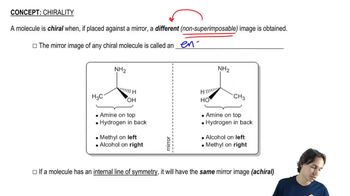
Chirality

Chirality refers to the property of a molecule that makes it non-superimposable on its mirror image, much like how left and right hands are mirror images but cannot be perfectly aligned. Chiral molecules often exist as pairs of enantiomers, which are two compounds that are mirror images of each other. This property is crucial in organic chemistry, especially in the context of drug design, as different enantiomers can have vastly different biological effects.
Recommended video:
Guided course
05:10
What is chirality?

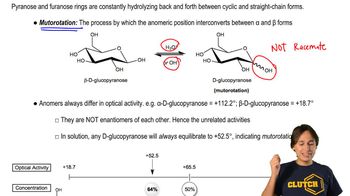
Optical Activity

Optical activity is the ability of chiral substances to rotate the plane of polarized light. The direction of this rotation can be clockwise (dextrorotatory, denoted as '+') or counterclockwise (levorotatory, denoted as '−'). This property is used to distinguish between enantiomers, as each enantiomer will rotate light in opposite directions, providing a method for their identification and characterization.
Recommended video:
Guided course
08:17
Mutorotation and Optical Activity

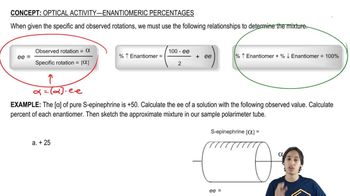
Enantiomers

Enantiomers are a specific type of stereoisomer that are non-superimposable mirror images of each other. They have identical physical properties in an achiral environment but can exhibit different behaviors in biological systems due to their distinct spatial arrangements. Understanding the relationship between enantiomers is essential in organic chemistry, particularly in pharmacology, where one enantiomer may be therapeutically active while the other could be inactive or harmful.
Recommended video:
Guided course
03:23
How to solve for the percentage of each enantiomer.
Related Practice
Textbook Question

Naproxen is a commercially available anti-inflammatory sold under the name Aleve.

(a) Assign the absolute configuration as R or S.

1
views

Textbook Question

Based on the absolute configuration of (S)-butan-2-ol, what can you say about the direction it rotates plane-polarized light?

1
views
Textbook Question

A student wanted to measure the specific rotation of the following propionate derivative (density = 1.12 g/ml).

A sample of the pure compound was placed in a 10.0-cm polarimeter tube, and using the sodium D line, the observed rotation at 20°C was determined to be +46.6° . What is the specific rotation of the propionate derivative?

Textbook Question

Prioritize the substituents at each chiral center and then, by each of the two methods discussed in Section 6.3.2.4, determine the absolute configuration. [Do not use your models, except to check your answers.]

(h)

4
views
Textbook Question

Cholesterol (50 mg) was dissolved in 10 mL of chloroform and placed in a 1.0-cm polarimeter cell. This solution produced an observed rotation (using the sodium D line at 20°C ) of - 1.58° . What is the specific rotation of cholesterol?

1
views
Textbook Question

(R)-Limonene is a cyclic terpene responsible for the smell of oranges and other citrus fruits.

(a) Given that (R)-limonene rotates plane-polarized light in the clockwise direction, should it be referred to as (d) or (l)?

(b) Is it (+) or (-)?

(c) What direction (d or l; + or −) would you expect (S)-limonene to rotate plane-polarized light?

2
views