Ch. 6 - Stereoisomerism: Arrangement of Atoms in Space
Mullins - Organic Chemistry: A Learner Centered Approach 1st Edition
Mullins1st EditionOrganic Chemistry: A Learner Centered ApproachISBN: 9780137566471Not the one you use?Change textbook
Chapter 5, Problem 26

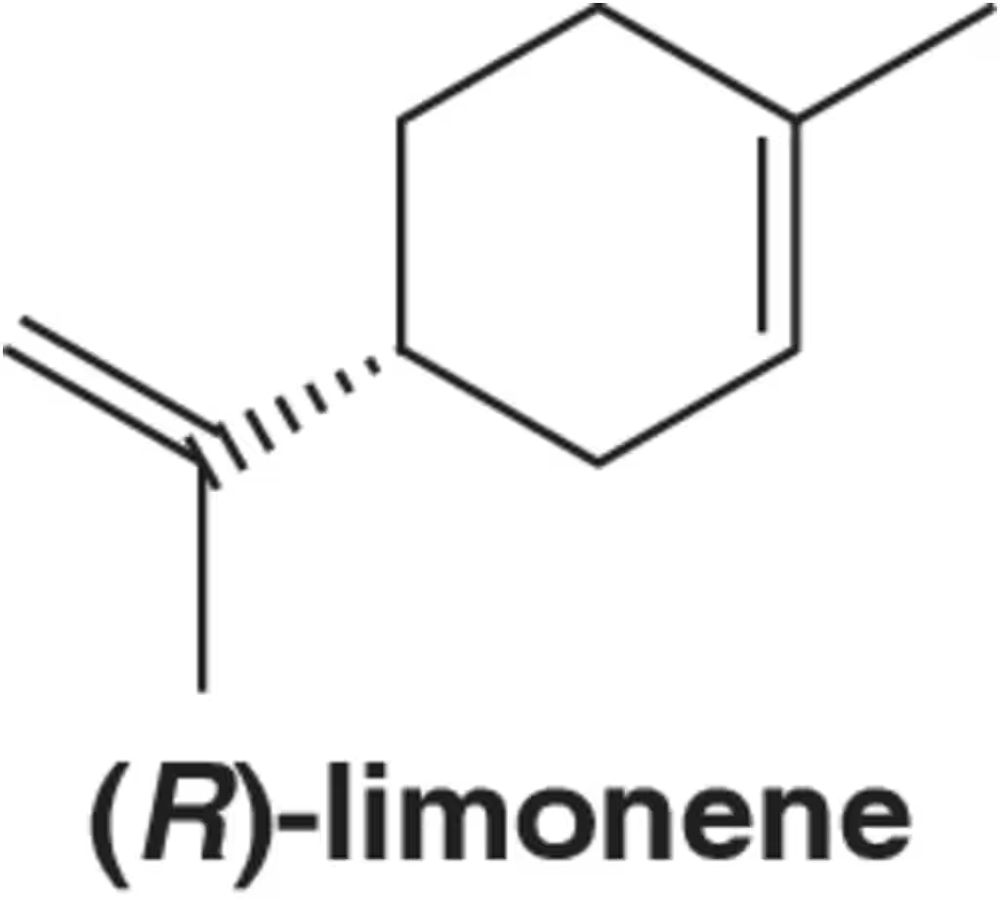
(R)-Limonene is a cyclic terpene responsible for the smell of oranges and other citrus fruits.
(a) Given that (R)-limonene rotates plane-polarized light in the clockwise direction, should it be referred to as (d) or (l)?
(b) Is it (+) or (-)?
(c) What direction (d or l; + or −) would you expect (S)-limonene to rotate plane-polarized light?
Chemical structure of (R)-limonene, a cyclic terpene with a citrus scent, labeled clearly for educational purposes.

Verified step by step guidance
1
Step 1: Understand the relationship between the (R) and (S) stereochemical designations and the direction of rotation of plane-polarized light. The (R) and (S) designations are based on the Cahn-Ingold-Prelog priority rules and do not directly indicate the direction of optical rotation.
Step 2: Recall that the terms (d) and (l) refer to dextrorotatory and levorotatory, respectively. A compound is dextrorotatory (d) if it rotates plane-polarized light clockwise, and levorotatory (l) if it rotates plane-polarized light counterclockwise. Since (R)-limonene rotates light clockwise, it should be referred to as (d).
Step 3: Understand the relationship between the (+) and (−) notation and optical rotation. The (+) notation corresponds to clockwise rotation (dextrorotatory), while the (−) notation corresponds to counterclockwise rotation (levorotatory). Since (R)-limonene rotates light clockwise, it is also (+).
Step 4: Consider the stereochemical inversion from (R)-limonene to (S)-limonene. The (S)-enantiomer of a chiral compound typically rotates plane-polarized light in the opposite direction to its (R)-enantiomer. Therefore, if (R)-limonene is (d) and (+), (S)-limonene would be (l) and (−).
Step 5: Summarize the findings: (a) (R)-limonene is (d), (b) (R)-limonene is (+), and (c) (S)-limonene is expected to be (l) and (−), as it rotates plane-polarized light in the opposite direction to (R)-limonene.

Verified video answer for a similar problem:

This video solution was recommended by our tutors as helpful for the problem above.
Was this helpful?

Key Concepts

Here are the essential concepts you must grasp in order to answer the question correctly.

Optical Activity

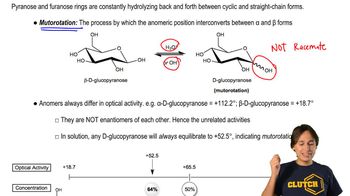
Optical activity refers to the ability of chiral compounds to rotate the plane of polarized light. This property arises from the asymmetry of the molecule, which can exist in two enantiomeric forms that rotate light in opposite directions. The direction of rotation is designated as clockwise (dextrorotatory, +) or counterclockwise (levorotatory, -). Understanding optical activity is crucial for distinguishing between enantiomers.
Recommended video:
Guided course
08:17
Mutorotation and Optical Activity

Enantiomers and Chirality

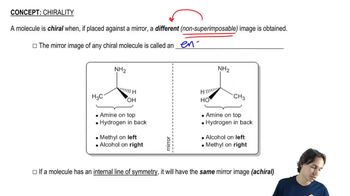
Enantiomers are pairs of molecules that are non-superimposable mirror images of each other, typically due to the presence of a chiral center. Chirality is a key concept in organic chemistry, as it affects the physical and chemical properties of compounds, including their interaction with polarized light. The designation of enantiomers as (R) or (S) is based on the Cahn-Ingold-Prelog priority rules, which help determine their spatial arrangement.
Recommended video:
Guided course
05:10
What is chirality?

Cahn-Ingold-Prelog System

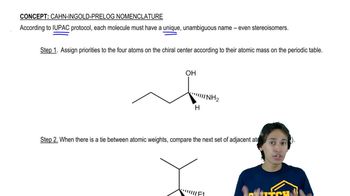
The Cahn-Ingold-Prelog (CIP) system is a set of rules used to assign the configuration of chiral centers in molecules. It involves ranking the substituents attached to the chiral carbon based on atomic number and connectivity. The configuration is designated as (R) for clockwise and (S) for counterclockwise arrangement when viewed from a specific perspective. This system is essential for accurately describing the stereochemistry of organic compounds.
Recommended video:
Guided course
01:48
Why stereoisomers need their own naming system.