
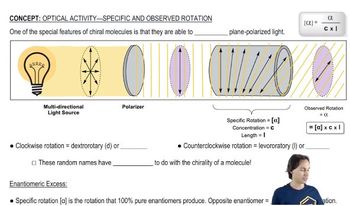
Using a 1.0-cm polarimeter cell and a solution prepared by dissolving 2.54 g of glucose in 1 L of H₂O, the specific rotation of d-glucose was calculated to be +52.7° at 20 °C using the sodium D line as the source of light. What was the observed rotation of the solution?

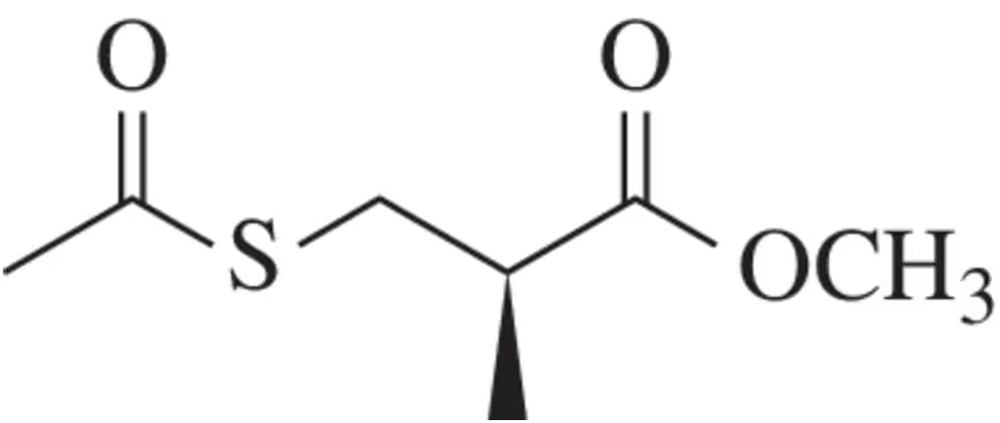
A student wanted to measure the specific rotation of the following propionate derivative (density = 1.12 g/ml).

A sample of the pure compound was placed in a 10.0-cm polarimeter tube, and using the sodium D line, the observed rotation at 20°C was determined to be +46.6° . What is the specific rotation of the propionate derivative?
Verified step by step guidance
Verified video answer for a similar problem:
Key Concepts
Specific Rotation
Polarimetry
Concentration and Path Length
Naproxen is a commercially available anti-inflammatory sold under the name Aleve.
(a) Assign the absolute configuration as R or S.
Based on the absolute configuration of (S)-butan-2-ol, what can you say about the direction it rotates plane-polarized light?
Imagine a sample that is enriched in the R enantiomer. If the % ee of the sample is 83%,
(a) what percent of the mixture is racemic?
(b) What is the ratio of R to S?
Naproxen is a commercially available anti-inflammatory sold under the name Aleve.
(b) Given that naproxen rotates plane-polarized light in the clockwise direction, should it be referred to as (d) or (l)?
(c) Is it (+) or (-)?
(d) What direction (d or l; + or −) would you expect the enantiomer of naproxen to rotate plane-polarized light?
Cholesterol (50 mg) was dissolved in 10 mL of chloroform and placed in a 1.0-cm polarimeter cell. This solution produced an observed rotation (using the sodium D line at 20°C ) of - 1.58° . What is the specific rotation of cholesterol?
