
Ch. 6 - Stereoisomerism: Arrangement of Atoms in Space
Mullins - Organic Chemistry: A Learner Centered Approach 1st Edition
Mullins1st EditionOrganic Chemistry: A Learner Centered ApproachISBN: 9780137566471Not the one you use?Change textbook
Chapter 5, Problem 62

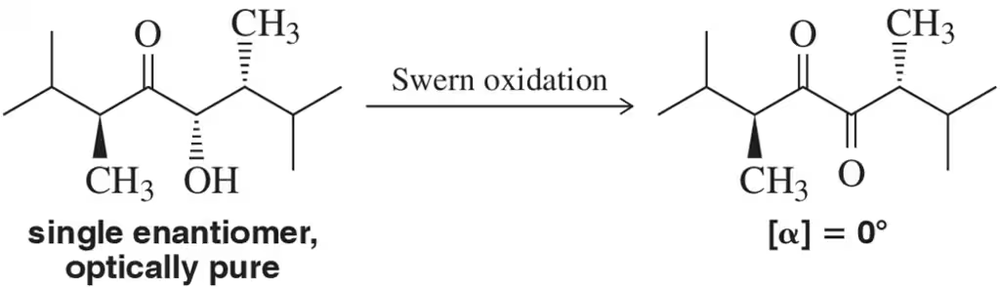
In Chapter 13, we explain how to convert secondary alcohols into ketones using a mild oxidation reaction. When the following enantiomerically pure and optically active secondary alcohol is submitted to these reaction conditions, the product is optically inactive. Explain this observation.
Diagram showing Swern oxidation of an optically pure secondary alcohol to an optically inactive ketone.

Verified step by step guidance
1
Identify the structure of the secondary alcohol. A secondary alcohol has the hydroxyl group (-OH) attached to a carbon atom that is also connected to two other carbon atoms.
Understand the concept of enantiomers. Enantiomers are molecules that are non-superimposable mirror images of each other. They have chiral centers, which are carbon atoms bonded to four different groups.
Recognize that the oxidation of a secondary alcohol to a ketone involves the removal of hydrogen atoms from the carbon bearing the hydroxyl group, forming a carbonyl group (C=O).
Consider the stereochemistry of the reaction. The oxidation of a secondary alcohol to a ketone typically results in the loss of chirality at the carbon atom where the hydroxyl group was attached, as the carbonyl group is planar and does not have a chiral center.
Conclude that the product is optically inactive because the ketone formed is achiral. The reaction converts the chiral secondary alcohol into an achiral ketone, resulting in a loss of optical activity.

Verified video answer for a similar problem:

This video solution was recommended by our tutors as helpful for the problem above.
Video duration:
5m
Was this helpful?

Key Concepts

Here are the essential concepts you must grasp in order to answer the question correctly.

Chirality and Optical Activity

Chirality in molecules refers to the presence of a carbon atom bonded to four different groups, resulting in non-superimposable mirror images called enantiomers. These enantiomers can rotate plane-polarized light, a property known as optical activity. A racemic mixture, containing equal amounts of both enantiomers, is optically inactive because the rotations cancel each other out.
Recommended video:
Guided course
08:17
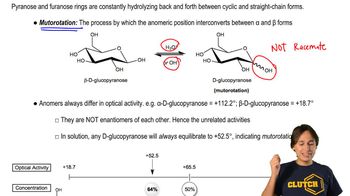
Mutorotation and Optical Activity

Oxidation of Alcohols

Oxidation of alcohols involves the increase in the oxidation state of the carbon atom bonded to the hydroxyl group. Secondary alcohols can be oxidized to ketones using mild oxidizing agents. This reaction typically involves the removal of hydrogen atoms from the alcohol, forming a carbonyl group, which does not possess chirality, leading to a loss of optical activity.
Recommended video:
Guided course
05:53
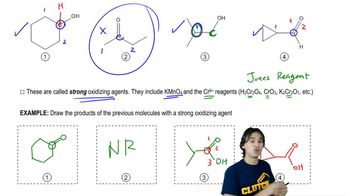
Strong oxidizing agents

Formation of Achiral Compounds

When a chiral secondary alcohol is oxidized to a ketone, the resulting ketone is often achiral because the carbonyl carbon is bonded to two identical groups. This transformation results in a molecule that lacks a chiral center, thus becoming optically inactive. The loss of chirality during the reaction explains why the product does not rotate plane-polarized light.
Recommended video:
Guided course
01:40
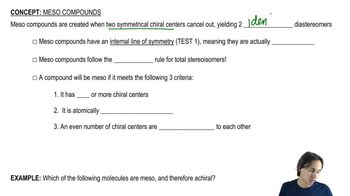
Defining meso compounds.
Related Practice
Textbook Question

A chemist working on the synthesis of (+)-pilocarpine, an alkaloid used in the treatment of dry mouth and glaucoma, produced a mixture of enantiomers that gave a specific rotation [α]D = +97°. Based on the specific rotation of the pure enantiomer, calculate the ratio of (+)- to (-)-pilocarpine produced by the chemist.

7
views
Textbook Question

Chromatography using a chiral stationary phase is able to separate a pair of enantiomers because one of the enantiomers forms a more tightly bound complex with the stationary phase. Assuming that the (S) enantiomer elutes more slowly, rationalize this result on a reaction coordinate diagram.

1
views
Textbook Question

A compound with two chiral centers that is meso will always have opposite absolute configurations at the two chiral centers. That is, a meso compound will never be (R,R) or (S,S); instead, it will be (R,S). Explain why this must be true.

1
views
Textbook Question

In contrast to Assessment 6.63, the following compounds should be easily separable using standard methods. Why?

1
views
Textbook Question

A chemist prepared a racemic mixture of the enantiomeric sulfonic acids shown here. Suggest two ways that these might be separated.

2
views
Textbook Question

In Chapter 12, we introduce the SN2 reaction, a nucleophilic substitution reaction that proceeds with inversion. Confirm that inversion has occurred in each of the following examples by determining the absolute configuration of the chiral center in the reactants and products.

(a)

3
views