

Ch. 6 - Stereoisomerism: Arrangement of Atoms in Space
Mullins - Organic Chemistry: A Learner Centered Approach 1st Edition
Mullins1st EditionOrganic Chemistry: A Learner Centered ApproachISBN: 9780137566471Not the one you use?Change textbook
Chapter 5, Problem 65

Chromatography using a chiral stationary phase is able to separate a pair of enantiomers because one of the enantiomers forms a more tightly bound complex with the stationary phase. Assuming that the (S) enantiomer elutes more slowly, rationalize this result on a reaction coordinate diagram.
Reaction coordinate diagram illustrating the interaction of enantiomers with a chiral stationary phase to form diastereomeric complexes.

Verified step by step guidance
1
Understand the concept of enantiomers: Enantiomers are stereoisomers that are non-superimposable mirror images of each other. They often exhibit identical physical properties but can interact differently with chiral environments, such as a chiral stationary phase in chromatography.
Recognize the role of the chiral stationary phase: A chiral stationary phase contains a chiral environment that can interact differently with the (R) and (S) enantiomers. This differential interaction leads to varying retention times for the enantiomers during chromatography.
Analyze the binding interaction: The (S) enantiomer forms a more tightly bound complex with the chiral stationary phase compared to the (R) enantiomer. This stronger interaction increases the activation energy required for the (S) enantiomer to elute, causing it to move more slowly through the column.
Construct the reaction coordinate diagram: On the diagram, plot the energy of the system as a function of the progress of the elution process. Represent the (S) enantiomer with a higher energy barrier (activation energy) compared to the (R) enantiomer, indicating its stronger binding to the stationary phase.
Interpret the diagram: The higher energy barrier for the (S) enantiomer corresponds to its slower elution rate. This difference in activation energy explains why the (S) enantiomer elutes more slowly than the (R) enantiomer in the chromatographic process.

Verified video answer for a similar problem:

This video solution was recommended by our tutors as helpful for the problem above.
Was this helpful?

Key Concepts

Here are the essential concepts you must grasp in order to answer the question correctly.

Chirality and Enantiomers

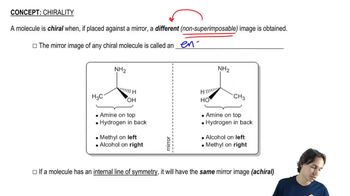
Chirality refers to the property of a molecule that makes it non-superimposable on its mirror image, leading to the existence of enantiomers—two molecules that are mirror images of each other. In organic chemistry, enantiomers can exhibit different behaviors in chiral environments, such as when interacting with a chiral stationary phase in chromatography, which can lead to differences in their retention times.
Recommended video:
Guided course
05:10
What is chirality?

Chiral Stationary Phase

A chiral stationary phase is a type of stationary phase used in chromatography that contains chiral molecules. This phase selectively interacts with enantiomers, allowing for their separation based on differences in binding affinity. The enantiomer that forms a stronger interaction with the stationary phase will elute more slowly, as it takes longer to overcome the energy barrier associated with its binding.
Recommended video:
1:53
Merrifield Solid-Phase Peptide Synthesis Concept 1

Reaction Coordinate Diagram

A reaction coordinate diagram is a graphical representation that illustrates the energy changes during a chemical reaction as a function of the reaction progress. In the context of chromatography, it can be used to visualize the energy barriers associated with the formation of complexes between the enantiomers and the chiral stationary phase. The diagram helps rationalize why one enantiomer elutes more slowly by showing that it has a higher activation energy or a more stable transition state compared to the other.
Recommended video:
Guided course
05:02
Coordination Complexes