
Ch. 6 - Stereoisomerism: Arrangement of Atoms in Space
Mullins - Organic Chemistry: A Learner Centered Approach 1st Edition
Mullins1st EditionOrganic Chemistry: A Learner Centered ApproachISBN: 9780137566471Not the one you use?Change textbook
Chapter 5, Problem 58

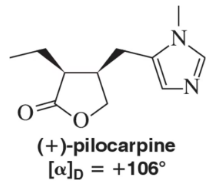
A chemist working on the synthesis of (+)-pilocarpine, an alkaloid used in the treatment of dry mouth and glaucoma, produced a mixture of enantiomers that gave a specific rotation [α]D = +97°. Based on the specific rotation of the pure enantiomer, calculate the ratio of (+)- to (-)-pilocarpine produced by the chemist.

Verified step by step guidance
1
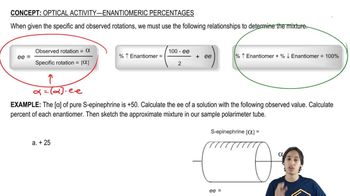
Step 1: Understand the concept of enantiomeric excess (ee). Enantiomeric excess is a measure of the purity of one enantiomer in a mixture of enantiomers. It is calculated using the formula: ee = (observed specific rotation / specific rotation of pure enantiomer) × 100%.
Step 2: Substitute the given values into the formula for enantiomeric excess. The observed specific rotation is [α]D = +97°, and the specific rotation of the pure (+)-pilocarpine enantiomer is [α]D = +106°.
Step 3: Calculate the enantiomeric excess (ee) using the formula: ee = ((+97°) / (+106°)) × 100%. This will give the percentage of excess of the (+)-enantiomer over the (-)-enantiomer.
Step 4: Relate the enantiomeric excess to the ratio of the enantiomers. The enantiomeric excess represents the difference in percentage between the two enantiomers. Use the formula: % (+)-enantiomer = (ee + 100) / 2 and % (-)-enantiomer = 100 - % (+)-enantiomer.
Step 5: Express the ratio of (+)- to (-)-pilocarpine. Once the percentages of each enantiomer are determined, the ratio can be expressed as % (+)-enantiomer : % (-)-enantiomer.

Verified video answer for a similar problem:

This video solution was recommended by our tutors as helpful for the problem above.
Video duration:
8m
Was this helpful?

Key Concepts

Here are the essential concepts you must grasp in order to answer the question correctly.

Enantiomers

Enantiomers are a type of stereoisomer that are non-superimposable mirror images of each other. They have identical physical properties except for their interaction with plane-polarized light, where one enantiomer rotates light in one direction and the other in the opposite direction. Understanding enantiomers is crucial for analyzing the optical activity of chiral compounds like pilocarpine.
Recommended video:
Guided course
03:23
How to solve for the percentage of each enantiomer.

Specific Rotation

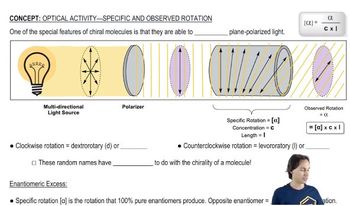
Specific rotation is a measure of how much a chiral compound can rotate plane-polarized light, expressed as [α]_D. It is defined as the observed rotation at a specific wavelength (usually sodium D-line) and temperature, divided by the concentration of the solution and the path length of the light. This property is essential for determining the purity and composition of enantiomeric mixtures.
Recommended video:
Guided course
05:43
Specific rotation vs. observed rotation.

Optical Purity

Optical purity is a measure of the ratio of the amount of one enantiomer to the total amount of both enantiomers in a mixture. It can be calculated using the specific rotation of the mixture and the specific rotation of the pure enantiomer. This concept is vital for quantifying the enantiomeric composition of the pilocarpine mixture produced by the chemist.
Recommended video:
Guided course
08:17
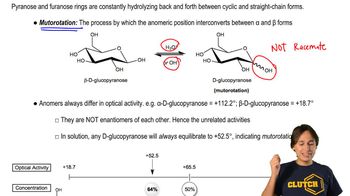
Mutorotation and Optical Activity
Related Practice
Textbook Question

When the following substituted biphenyl was synthesized, it was found to have a specific rotation [α] of -23° at 25°C . When the specific rotation was measured at 100°C the compound had a specific rotation of 0° . Upon cooling back to 25°C the specific rotation was measured again, resulting in [α] = 0°. Explain these results.

1
views
Textbook Question

As we learned in Chapter 2, we don't need to show hydrogens bonded to carbons when drawing organic molecules using line-angle formulas. At asymmetric centers, however, we often show the hydrogen. Why? When might it be unnecessary to show the hydrogen at a chiral center?

2
views
Textbook Question

In Chapter 13, we explain how to convert secondary alcohols into ketones using a mild oxidation reaction. When the following enantiomerically pure and optically active secondary alcohol is submitted to these reaction conditions, the product is optically inactive. Explain this observation.

1
views
Textbook Question

A compound with two chiral centers that is meso will always have opposite absolute configurations at the two chiral centers. That is, a meso compound will never be (R,R) or (S,S); instead, it will be (R,S). Explain why this must be true.

1
views
Textbook Question

Natural products are organic compounds produced by living organisms, including plants, fungi, and animals. Often referred to as secondary metabolites because they are not required for survival of the organism, natural products have found broad utility as drugs themselves or as lead compounds used in the development of medicines. One such example is paclitaxel, which has been used as a cancer drug. Paclitaxel is isolated from the yew tree, where it is produced as a single stereoisomer (shown). Based on its structure, how many stereoisomers are possible for paclitaxel?

Textbook Question

In Chapter 12, we introduce the SN2 reaction, a nucleophilic substitution reaction that proceeds with inversion. Confirm that inversion has occurred in each of the following examples by determining the absolute configuration of the chiral center in the reactants and products.

(a)

3
views