
Ch. 6 - Stereoisomerism: Arrangement of Atoms in Space
Mullins - Organic Chemistry: A Learner Centered Approach 1st Edition
Mullins1st EditionOrganic Chemistry: A Learner Centered ApproachISBN: 9780137566471Not the one you use?Change textbook
Chapter 5, Problem 55

As we learned in Chapter 2, we don't need to show hydrogens bonded to carbons when drawing organic molecules using line-angle formulas. At asymmetric centers, however, we often show the hydrogen. Why? When might it be unnecessary to show the hydrogen at a chiral center?

Verified step by step guidance
1
Understand the concept of asymmetric centers: An asymmetric center, also known as a chiral center, is a carbon atom bonded to four different groups. This arrangement leads to chirality, which is the property of a molecule having non-superimposable mirror images.
Recognize the importance of showing hydrogens at asymmetric centers: Showing the hydrogen at a chiral center is crucial because it helps to clearly define the stereochemistry of the molecule. The spatial arrangement of the groups around the chiral center determines the molecule's configuration (R or S).
Learn when it might be unnecessary to show the hydrogen: If the stereochemistry of the molecule is already explicitly indicated using wedge-and-dash bonds or other stereochemical notations, the hydrogen may not need to be shown. For example, if the configuration is labeled as R or S, the hydrogen's position can be inferred without explicitly drawing it.
Consider the context of the drawing: In some cases, such as when simplifying complex molecules or focusing on specific functional groups, omitting the hydrogen at a chiral center might be acceptable. However, this should only be done if the stereochemistry is not the focus of the discussion or if it is already well understood.
Practice interpreting line-angle formulas: To become proficient in understanding organic structures, practice interpreting line-angle formulas with and without hydrogens at chiral centers. This will help you recognize when the hydrogen is necessary for clarity and when it can be omitted without losing critical information.

Verified video answer for a similar problem:

This video solution was recommended by our tutors as helpful for the problem above.
Video duration:
7m
Was this helpful?

Key Concepts

Here are the essential concepts you must grasp in order to answer the question correctly.

Line-Angle Formulas

Line-angle formulas are a simplified way of representing organic molecules where vertices represent carbon atoms and lines represent bonds. This notation omits hydrogen atoms bonded to carbons for clarity, making it easier to visualize complex structures. However, at chiral centers, showing hydrogen can be crucial for understanding stereochemistry.
Recommended video:
Guided course
02:46
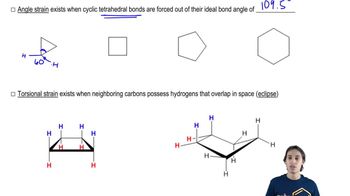
What is angle strain?

Chirality and Asymmetric Centers

Chirality refers to the property of a molecule that makes it non-superimposable on its mirror image, often due to the presence of an asymmetric center, typically a carbon atom bonded to four different substituents. This unique arrangement leads to the existence of enantiomers, which are important in biological systems and pharmaceuticals. Showing hydrogen at these centers helps clarify the spatial arrangement of substituents.
Recommended video:
Guided course
05:41
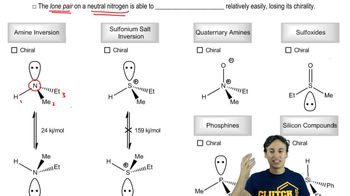
Understanding Other Chiral Atoms

Stereochemistry

Stereochemistry is the study of the spatial arrangement of atoms in molecules and how this affects their chemical behavior. In the context of chiral centers, it is essential to represent all substituents accurately, including hydrogen, to convey the correct three-dimensional orientation. In some cases, if the hydrogen is implied and does not affect the stereochemical outcome, it may be omitted for simplicity.
Recommended video:
1:38
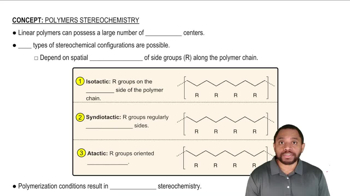
Polymer Stereochemistry Concept 1
Related Practice
Textbook Question

A chemist working on the synthesis of (+)-pilocarpine, an alkaloid used in the treatment of dry mouth and glaucoma, produced a mixture of enantiomers that gave a specific rotation [α]D = +97°. Based on the specific rotation of the pure enantiomer, calculate the ratio of (+)- to (-)-pilocarpine produced by the chemist.

7
views
Textbook Question

When the following substituted biphenyl was synthesized, it was found to have a specific rotation [α] of -23° at 25°C . When the specific rotation was measured at 100°C the compound had a specific rotation of 0° . Upon cooling back to 25°C the specific rotation was measured again, resulting in [α] = 0°. Explain these results.

1
views
Textbook Question

A compound with two chiral centers that is meso will always have opposite absolute configurations at the two chiral centers. That is, a meso compound will never be (R,R) or (S,S); instead, it will be (R,S). Explain why this must be true.

1
views
Textbook Question

Complete the structure of each of these so that it matches the (R) or (S) configuration associated with the name.

(e)

6
views
Textbook Question

Draw the enantiomer of each of the molecules you drew in Assessment 6.52.

1
views
Textbook Question

Natural products are organic compounds produced by living organisms, including plants, fungi, and animals. Often referred to as secondary metabolites because they are not required for survival of the organism, natural products have found broad utility as drugs themselves or as lead compounds used in the development of medicines. One such example is paclitaxel, which has been used as a cancer drug. Paclitaxel is isolated from the yew tree, where it is produced as a single stereoisomer (shown). Based on its structure, how many stereoisomers are possible for paclitaxel?