Keto–enol tautomerism is a reaction we discuss in detail in Chapter 19. Estimate the equilibrium constant of this reaction (BDE for C―C π bond = 65 kcal/mol ; for C―O π bond = 85 kcal/mol).
Ch. 5 - Chemical Reaction Analysis: Thermodynamics and Kinetics

Mullins1st EditionOrganic Chemistry: A Learner Centered ApproachISBN: 9780137566471Not the one you use?Change textbook
All textbooks
Mullins 1st Edition
Ch. 5 - Chemical Reaction Analysis: Thermodynamics and Kinetics
Problem 59c
Mullins 1st Edition
Ch. 5 - Chemical Reaction Analysis: Thermodynamics and Kinetics
Problem 59cChapter 4, Problem 59c
Reaction (c), on the other hand, is favored (∆G° < 0). Identify the bonds formed and broken and explain this result in light of (a) and (b).
(c) 
Verified step by step guidance1
Identify the bonds broken and formed in reaction (c). For example, analyze the reactants and products to determine which bonds are cleaved and which new bonds are created. Use structural formulas to visualize this process.
Recall that the Gibbs free energy change (∆G°) is related to the bond energies of the bonds broken and formed. Breaking bonds requires energy (endothermic), while forming bonds releases energy (exothermic).
Compare the bond energies of the bonds broken and formed. If the bonds formed are stronger (have higher bond energy) than the bonds broken, the reaction will release energy, making ∆G° negative and the reaction thermodynamically favorable.
Relate this result to reactions (a) and (b). Consider whether the same types of bonds are involved and whether the energy changes in (c) are consistent with the trends observed in (a) and (b).
Conclude by explaining why reaction (c) is favored (∆G° < 0) based on the net energy change from bond breaking and forming, and how this aligns with the thermodynamic principles of exergonic reactions.

Verified video answer for a similar problem:
This video solution was recommended by our tutors as helpful for the problem above.
Video duration:
8mWas this helpful?
Key Concepts
Here are the essential concepts you must grasp in order to answer the question correctly.
Gibbs Free Energy (∆G)
Gibbs Free Energy (∆G) is a thermodynamic potential that measures the maximum reversible work obtainable from a thermodynamic system at constant temperature and pressure. A negative value of ∆G (∆G° < 0) indicates that a reaction is spontaneous, meaning it can occur without external energy input. Understanding this concept is crucial for analyzing the favorability of chemical reactions and predicting their direction.
Recommended video:
Guided course
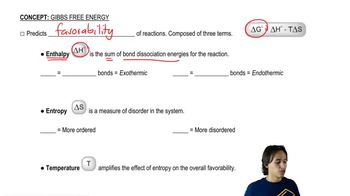
Breaking down the different terms of the Gibbs Free Energy equation.
Bond Formation and Breaking
In chemical reactions, bonds between atoms are either formed or broken, which directly influences the energy changes in the system. When bonds are formed, energy is released, contributing to a negative ∆G, while breaking bonds requires energy input. Identifying which specific bonds are involved in the reaction helps in understanding the overall energy dynamics and the reaction's favorability.
Recommended video:
Guided course
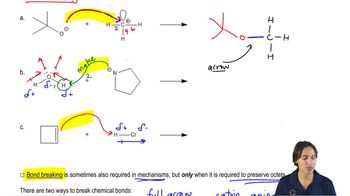
Identifying Bond Breaking
Reaction Mechanism
A reaction mechanism describes the step-by-step sequence of elementary reactions by which overall chemical change occurs. It provides insight into how reactants transform into products, including the intermediates formed and the transition states. Analyzing the mechanism helps explain why certain reactions are favored or not, particularly in relation to the energy changes associated with bond formation and breaking.
Recommended video:
Guided course
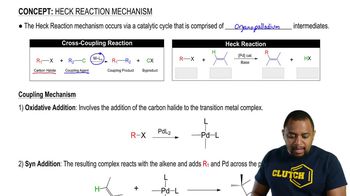
Heck Reaction Mechanism
Related Practice
Textbook Question
2
views
Textbook Question
Calculate ∆H° for the following alkene addition reaction, one we discuss further in Chapter 7. Predict the sign of ∆S° . (The BDE for C―C π bond is approximately 65 kcal/mol.)
1
views
Textbook Question
The hydrogenation of alkenes is a reaction we study in Chapter 9.
(b) Is this reaction favored or disfavored in terms of entropy?
Textbook Question
(b) Mechanistically, the reaction occurs as shown below. Why is this reaction favored? Based on the stability of the anions, estimate Keq.
2
views
Textbook Question
Calculate Keq for the following acid–base reaction.
1
views
Textbook Question
Reactions (a) and (b) are disfavored overall (∆G° > 0), yet they are favored based on ∆H°. Identify the bonds formed and broken for (a) and (b).
(b)
3
views