Ch. 27 - Carbohydrates, Nucleic Acids, and Lipids
Mullins - Organic Chemistry: A Learner Centered Approach 1st Edition
Mullins1st EditionOrganic Chemistry: A Learner Centered ApproachISBN: 9780137566471Not the one you use?Change textbook
Chapter 26, Problem 32b

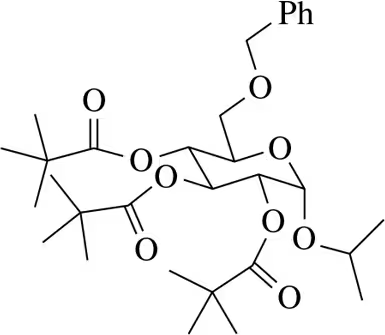
Suggest a synthesis of the following acylated sugars.
(b) Chemical structure of acylated sugars, featuring multiple hydroxyl and acyl groups, with a phenyl group attached.

Verified step by step guidance
1
Identify the sugar core structure in the acylated sugar. In this case, it appears to be a pyranose ring, which is a six-membered sugar ring.
Determine the acyl groups attached to the sugar. The image shows acetyl groups (CH3CO-) and a benzyl ether (PhCH2O-) attached to the sugar.
Plan the protection of hydroxyl groups on the sugar. Protect the hydroxyl groups using acetyl groups to prevent them from reacting during the synthesis.
Introduce the benzyl ether group. This can be done by reacting the protected sugar with benzyl chloride in the presence of a base to form the benzyl ether linkage.
Deprotect the sugar if necessary. If the synthesis requires the removal of protecting groups, use a deprotection step such as hydrolysis to remove the acetyl groups, leaving the desired acylated sugar structure.

Verified video answer for a similar problem:

This video solution was recommended by our tutors as helpful for the problem above.
Video duration:
4m
Was this helpful?

Key Concepts

Here are the essential concepts you must grasp in order to answer the question correctly.

Acylation

Acylation is a chemical reaction that introduces an acyl group into a molecule. In organic chemistry, this process often modifies the properties of sugars, enhancing their reactivity or solubility. Understanding the types of acyl groups and their effects on the sugar structure is crucial for synthesizing acylated sugars.
Recommended video:
Guided course
05:20
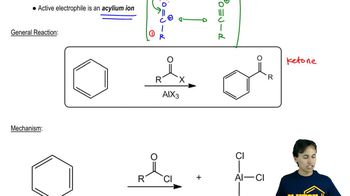
Friedel-Crafts Acylation

Synthesis of Sugars

The synthesis of sugars involves various chemical reactions to construct or modify carbohydrate structures. This includes the formation of glycosidic bonds and the introduction of functional groups. Knowledge of carbohydrate chemistry and reaction mechanisms is essential for designing effective synthetic pathways for acylated sugars.
Recommended video:
Guided course
08:42
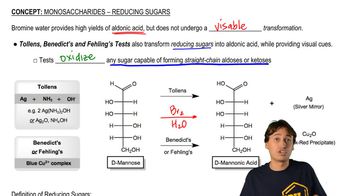
Reducing Sugars

Protecting Groups

Protecting groups are temporary modifications used to shield reactive functional groups during chemical reactions. In the synthesis of acylated sugars, protecting groups help prevent unwanted reactions at specific sites, allowing for selective acylation. Understanding how to choose and remove protecting groups is vital for successful sugar synthesis.
Recommended video:
Guided course
02:44
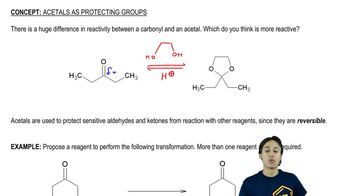
Protecting Groups