Ch. 27 - Carbohydrates, Nucleic Acids, and Lipids
Mullins - Organic Chemistry: A Learner Centered Approach 1st Edition
Mullins1st EditionOrganic Chemistry: A Learner Centered ApproachISBN: 9780137566471Not the one you use?Change textbook
Chapter 26, Problem 30a

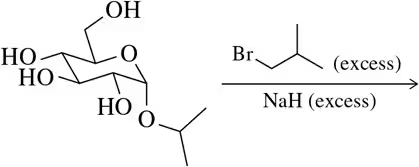
Predict the product of the following etherification reactions.
(a) Chemical structure showing a monosaccharide reacting with bromopropane and sodium hydride to predict etherification products.

Verified step by step guidance
1
Identify the functional groups in the starting material. The molecule on the left is a sugar derivative with multiple hydroxyl (OH) groups and an ether linkage.
Recognize the reagents used in the reaction. Sodium hydride (NaH) is a strong base that will deprotonate the hydroxyl groups, forming alkoxide ions.
Consider the role of the alkyl bromide (Br) in excess. It will act as an alkylating agent, reacting with the alkoxide ions to form ethers through an SN2 mechanism.
Predict the sites of etherification. Each deprotonated hydroxyl group can react with the alkyl bromide, leading to the formation of ether linkages at each hydroxyl site.
Visualize the final product. The sugar derivative will have its hydroxyl groups replaced by ether linkages with the alkyl group from the alkyl bromide, resulting in a fully etherified sugar derivative.

Verified video answer for a similar problem:

This video solution was recommended by our tutors as helpful for the problem above.
Video duration:
1m
Was this helpful?

Key Concepts

Here are the essential concepts you must grasp in order to answer the question correctly.

Etherification

Etherification is a chemical reaction that forms an ether from an alcohol and a suitable reagent, typically an alkyl halide or an acid. In this process, the hydroxyl group (-OH) of the alcohol is replaced by an alkoxy group (-O-R), resulting in the formation of an ether. Understanding the mechanism of etherification, including nucleophilic substitution reactions, is crucial for predicting the products of these reactions.

Nucleophilic Substitution

Nucleophilic substitution is a fundamental reaction mechanism in organic chemistry where a nucleophile attacks an electrophile, leading to the replacement of a leaving group. This mechanism can occur via two main pathways: SN1 (unimolecular) and SN2 (bimolecular), each with distinct kinetics and stereochemical outcomes. Recognizing the conditions that favor each pathway is essential for predicting the products of etherification reactions.
Recommended video:
Guided course
01:47
Nucleophiles and Electrophiles can react in Substitution Reactions.

Reactivity of Alcohols

The reactivity of alcohols in etherification reactions is influenced by their structure and the presence of functional groups. Primary alcohols typically undergo SN2 reactions, while secondary and tertiary alcohols may favor SN1 mechanisms due to steric hindrance. Understanding the classification of alcohols and their reactivity patterns is vital for accurately predicting the products formed in etherification.
Recommended video:
Guided course
01:01
How to name alcohols