Ch. 27 - Carbohydrates, Nucleic Acids, and Lipids
Mullins - Organic Chemistry: A Learner Centered Approach 1st Edition
Mullins1st EditionOrganic Chemistry: A Learner Centered ApproachISBN: 9780137566471Not the one you use?Change textbook
Chapter 26, Problem 24

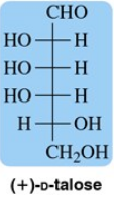
Draw the α- and β-anomers of d-talopyranose. [The structure of talose is in Figure 27.11.]
Structural representation of (+)-D-talose, showing its hydroxyl groups and aldehyde functional group.

Verified step by step guidance
1
Identify the structure of D-talose from the image. D-talose is an aldohexose with the configuration: C1 (CHO), C2 (OH on the left), C3 (OH on the left), C4 (OH on the left), C5 (OH on the right), and C6 (CH2OH).
Understand that pyranose forms are six-membered rings resulting from the reaction between the aldehyde group at C1 and the hydroxyl group at C5, forming a hemiacetal linkage.
To draw the α-anomer of D-talopyranose, form the pyranose ring by connecting C1 to C5. In the α-anomer, the OH group on C1 is trans to the CH2OH group at C5, meaning they are on opposite sides of the ring.
To draw the β-anomer of D-talopyranose, again form the pyranose ring by connecting C1 to C5. In the β-anomer, the OH group on C1 is cis to the CH2OH group at C5, meaning they are on the same side of the ring.
Ensure that the stereochemistry at C2, C3, and C4 remains the same as in the open-chain form, with the OH groups on C2, C3, and C4 positioned according to the original Fischer projection: C2 and C3 OH groups are equatorial, and C4 OH group is axial in the pyranose form.

Verified video answer for a similar problem:

This video solution was recommended by our tutors as helpful for the problem above.
Video duration:
3m
Was this helpful?

Key Concepts

Here are the essential concepts you must grasp in order to answer the question correctly.

Anomeric Carbon

The anomeric carbon is the carbon atom in a cyclic sugar that was the carbonyl carbon in the acyclic form. In the case of D-talopyranose, this is the carbon that forms the hemiacetal linkage, allowing for the formation of α- and β-anomers. The orientation of the hydroxyl group attached to this carbon determines the anomeric form.
Recommended video:
Guided course
02:12
Carbonation of Grignard Reagents

Pyranose Ring

A pyranose ring is a six-membered ring structure consisting of five carbon atoms and one oxygen atom, resembling the structure of pyran. D-talopyranose forms such a ring when D-talose cyclizes, and understanding this structure is crucial for drawing the α- and β-anomers, as it dictates the spatial arrangement of the hydroxyl groups.
Recommended video:
Guided course
05:14
Ring Expansion

α- and β-Anomers

Anomers are isomers of cyclic saccharides that differ in configuration at the anomeric carbon. For D-talopyranose, the α-anomer has the hydroxyl group on the anomeric carbon trans to the CH2OH group, while the β-anomer has it cis. This distinction is essential for correctly drawing the two forms of D-talopyranose.
Recommended video:
Guided course
02:20
Unique β-carbons and possible products