Ch. 27 - Carbohydrates, Nucleic Acids, and Lipids
Mullins - Organic Chemistry: A Learner Centered Approach 1st Edition
Mullins1st EditionOrganic Chemistry: A Learner Centered ApproachISBN: 9780137566471Not the one you use?Change textbook
Chapter 26, Problem 22

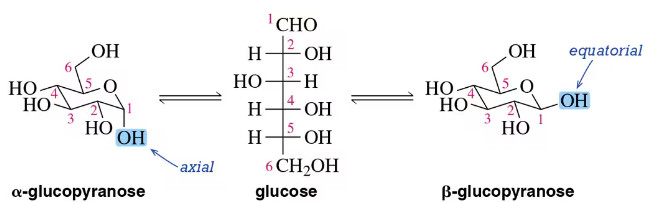
Suggest a mechanism by which α-d-glucopyranose is converted to β-d-glucopyranose in acid. [See Figure 27.18.]
Diagram illustrating the conversion of α-d-glucopyranose to β-d-glucopyranose, highlighting axial and equatorial positions of hydroxyl groups.

Verified step by step guidance
1
Identify the starting and ending structures: α-d-glucopyranose and β-d-glucopyranose. Notice that the difference is the position of the hydroxyl group at the anomeric carbon (C1), which is axial in α and equatorial in β.
Recognize that the conversion involves the opening of the pyranose ring to form the open-chain form of glucose, followed by reclosure to form the β-anomer.
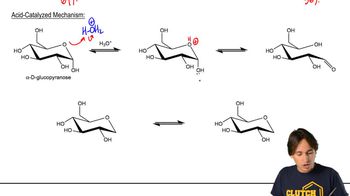
In acidic conditions, the reaction begins with the protonation of the oxygen in the hemiacetal linkage of α-d-glucopyranose, making it a better leaving group.
The ring opens to form the open-chain form of glucose, which is an aldehyde. This step involves the breaking of the C1-O bond, resulting in a linear form of glucose.
The open-chain form can then undergo ring closure again, but this time the hydroxyl group can attack the carbonyl carbon from the opposite side, leading to the formation of β-d-glucopyranose, where the hydroxyl group at C1 is now equatorial.

Verified video answer for a similar problem:

This video solution was recommended by our tutors as helpful for the problem above.
Video duration:
4m
Was this helpful?

Key Concepts

Here are the essential concepts you must grasp in order to answer the question correctly.

Anomeric Carbon

The anomeric carbon is the carbon atom in a sugar that is derived from the carbonyl carbon of the open-chain form. In cyclic sugars, it is the carbon that determines the alpha (α) or beta (β) configuration based on the orientation of the hydroxyl group. Understanding the role of the anomeric carbon is crucial for explaining the interconversion between α-d-glucopyranose and β-d-glucopyranose.
Recommended video:
Guided course
02:12
Carbonation of Grignard Reagents

Acid-Catalyzed Equilibrium

In an acid-catalyzed reaction, the presence of acid facilitates the conversion between different forms of a compound by protonating functional groups, making them more reactive. For the conversion of α-d-glucopyranose to β-d-glucopyranose, the acid helps to open the cyclic structure, allowing the molecule to equilibrate between its anomeric forms before closing again in the β configuration.
Recommended video:
Guided course
03:09
Acid Catalyzed

Mutarotation

Mutarotation is the process by which the specific rotation of a carbohydrate changes over time as it equilibrates between its anomeric forms. In the case of α-d-glucopyranose and β-d-glucopyranose, mutarotation involves the interconversion of these two forms in solution, which is facilitated by the presence of acid, leading to a dynamic equilibrium between the two anomers.
Recommended video: