Ch. 27 - Carbohydrates, Nucleic Acids, and Lipids
Mullins - Organic Chemistry: A Learner Centered Approach 1st Edition
Mullins1st EditionOrganic Chemistry: A Learner Centered ApproachISBN: 9780137566471Not the one you use?Change textbook
Chapter 26, Problem 34d

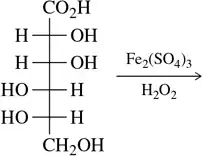
Predict the product of each of the following reactions.
(d) Structural formula of a monosaccharide with reaction conditions for Ruff degradation, showing reactants and products.

Verified step by step guidance
1
Identify the starting material: The structure shown is a sugar molecule, specifically a hexose, with a carboxylic acid group at the top and a primary alcohol group at the bottom.
Recognize the reagents: The reaction involves ferric sulfate (Fe2(SO4)3) and hydrogen peroxide (H2O2). This combination is often used as an oxidizing agent.
Determine the likely reaction: Given the presence of an oxidizing agent, the primary alcohol group at the bottom of the sugar molecule is likely to be oxidized to a carboxylic acid.
Predict the product: The oxidation of the primary alcohol group will result in the formation of a dicarboxylic acid, where both the top and bottom of the sugar molecule have carboxylic acid groups.
Consider stereochemistry: Ensure that the stereochemistry of the sugar molecule is maintained in the product, as the oxidation reaction does not affect the stereocenters in the middle of the molecule.

Verified video answer for a similar problem:

This video solution was recommended by our tutors as helpful for the problem above.
Video duration:
3m
Was this helpful?

Key Concepts

Here are the essential concepts you must grasp in order to answer the question correctly.

Ruff Degradation

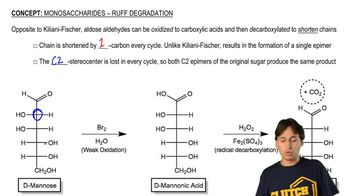
Ruff degradation is a chemical reaction used to shorten the carbon chain of aldoses by one carbon atom. It involves the oxidation of the aldose to an aldonic acid, followed by decarboxylation. In this reaction, the aldonic acid is treated with hydrogen peroxide and ferric sulfate, leading to the removal of the terminal carboxyl group as carbon dioxide, thus shortening the sugar by one carbon.
Recommended video:
Guided course
06:18
Monosaccharides - Ruff Degradation

Aldonic Acids

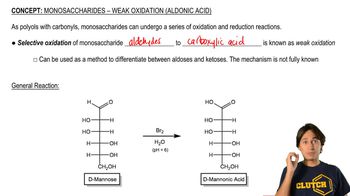
Aldonic acids are a type of sugar acid derived from aldoses, where the aldehyde group is oxidized to a carboxylic acid. In the context of Ruff degradation, the aldose is first converted into an aldonic acid before decarboxylation occurs. This transformation is crucial as it sets the stage for the subsequent removal of the carboxyl group, facilitating the shortening of the carbon chain.
Recommended video:
Guided course
04:15
Monosaccharides - Weak Oxidation (Aldonic Acid)

Decarboxylation

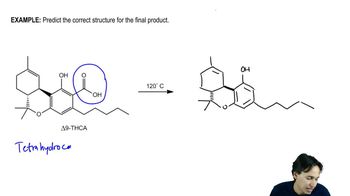
Decarboxylation is a chemical reaction that involves the removal of a carboxyl group, releasing carbon dioxide. In Ruff degradation, decarboxylation is the key step that results in the shortening of the sugar's carbon chain. The reaction conditions, including the presence of hydrogen peroxide and ferric sulfate, facilitate the decarboxylation of the aldonic acid, leading to the formation of a sugar with one less carbon atom.
Recommended video:
Guided course
02:32
Predict the correct structure