Ch. 24 - Benzene II: Reactions Influenced by the Aromatic Ring
Mullins - Organic Chemistry: A Learner Centered Approach 1st Edition
Mullins1st EditionOrganic Chemistry: A Learner Centered ApproachISBN: 9780137566471Not the one you use?Change textbook
Chapter 23, Problem 34j

Predict the product(s) of the following reactions.
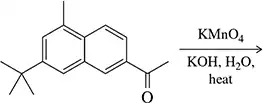
(j) Chemical structure showing a side-chain oxidation reaction with KMnO4, KOH, H2O, and heat as reagents.

Verified step by step guidance
1
Identify the functional groups present in the starting material. The compound is a ketone with an aromatic ring and an alkyl group attached.
Recognize the reagents used in the reaction: KMnO4, KOH, H2O, and heat. This combination is typically used for oxidative cleavage of alkenes or oxidation of alkyl side chains on aromatic rings.
Understand that KMnO4 under basic conditions (KOH) and heat will oxidize the alkyl side chain on the aromatic ring to a carboxylic acid.
Predict that the methyl group attached to the aromatic ring will be oxidized to a carboxylic acid group, resulting in the formation of a benzoic acid derivative.
Consider the stability of the aromatic ring during the reaction. The aromatic ring itself remains intact, while the side chain is oxidized to form the carboxylic acid product.

Verified video answer for a similar problem:

This video solution was recommended by our tutors as helpful for the problem above.
Was this helpful?

Key Concepts

Here are the essential concepts you must grasp in order to answer the question correctly.

Side-Chain Oxidation

Side-chain oxidation involves the conversion of alkyl side chains on aromatic rings into carboxylic acids. This reaction typically uses strong oxidizing agents like potassium permanganate (KMnO4) under basic conditions. The process is selective for benzylic positions, where the carbon atom is directly attached to the aromatic ring, leading to the formation of carboxylic acids.
Recommended video:
Guided course
06:14
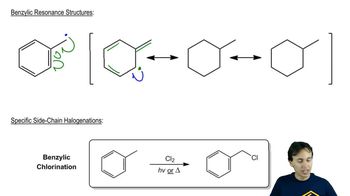
Side-Chain Halogenations

Role of Potassium Permanganate (KMnO4)

Potassium permanganate (KMnO4) is a powerful oxidizing agent used in organic chemistry to oxidize various functional groups. In the context of side-chain oxidation, KMnO4 oxidizes alkyl groups attached to aromatic rings, particularly at benzylic positions, converting them into carboxylic acids. The reaction typically requires basic conditions and heat to proceed efficiently.
Recommended video:
Guided course
00:49
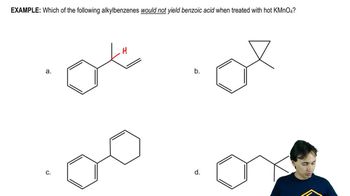
Which alkylbenzene would NOT yield benzoic acid, treated with KMnO4

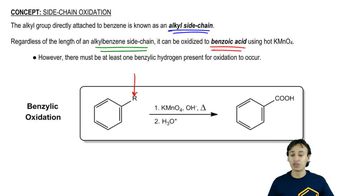
Benzylic Oxidation

Benzylic oxidation refers to the oxidation of a benzylic carbon, which is the carbon atom adjacent to an aromatic ring. This position is particularly reactive due to the stability provided by the aromatic ring. In the presence of oxidizing agents like KMnO4, benzylic carbons are preferentially oxidized to form carboxylic acids, making this a key step in transforming alkylbenzenes into benzoic acids.
Recommended video:
Guided course
03:20
Benzylic Oxidation