Ch. 24 - Benzene II: Reactions Influenced by the Aromatic Ring
Mullins - Organic Chemistry: A Learner Centered Approach 1st Edition
Mullins1st EditionOrganic Chemistry: A Learner Centered ApproachISBN: 9780137566471Not the one you use?Change textbook
Chapter 23, Problem 34f

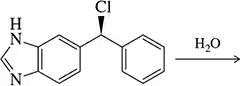
Predict the product(s) of the following reactions.
(f) Chemical structure showing a nitrogen compound with a chlorine atom and water as a reactant for substitution reactions.

Verified step by step guidance
1
Step 1: Analyze the given reactant structure. The molecule contains a triazole ring, a benzyl chloride group, and a phenyl group. The reaction involves water (H₂O), which suggests hydrolysis or substitution might occur.
Step 2: Identify the reactive site. The benzyl chloride group (C-Cl bond) is a good candidate for nucleophilic substitution because the benzyl position is activated for such reactions.
Step 3: Consider the mechanism. In the presence of water, the reaction likely proceeds via an SN1 mechanism due to the stability of the benzyl carbocation formed after the departure of the chloride ion.
Step 4: Predict the product. The nucleophile (H₂O) will attack the benzyl carbocation, leading to the formation of a benzyl alcohol group (-CH₂OH) in place of the chloride.
Step 5: Finalize the structure of the product. The triazole ring and phenyl group remain unchanged, while the benzyl chloride group is converted to a benzyl alcohol group. The product is 1-(1H-1,2,4-triazol-1-yl)-2-phenylethanol.

Verified video answer for a similar problem:

This video solution was recommended by our tutors as helpful for the problem above.
Video duration:
2m
Was this helpful?

Key Concepts

Here are the essential concepts you must grasp in order to answer the question correctly.

Nucleophilic Substitution

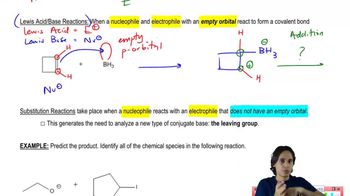
Nucleophilic substitution is a fundamental reaction in organic chemistry where a nucleophile attacks an electrophilic carbon atom, replacing a leaving group. In this case, the chlorine atom acts as the leaving group, and water can act as a nucleophile, leading to the formation of a new bond. Understanding this mechanism is crucial for predicting the products of the reaction.
Recommended video:
Guided course
01:47
Nucleophiles and Electrophiles can react in Substitution Reactions.

Electrophilicity of Halogens

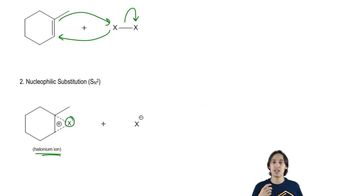
Halogens, such as chlorine, are highly electronegative and can stabilize a positive charge, making them good leaving groups in substitution reactions. The presence of chlorine in the compound indicates that it can be replaced by a nucleophile like water. Recognizing the role of halogens in organic reactions helps in predicting the outcome of the reaction.
Recommended video:
Guided course
03:45
Halogenation Mechanism

Reaction Conditions and Solvent Effects

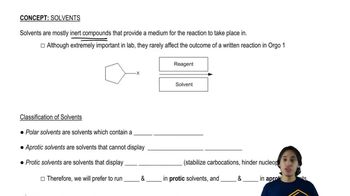
The solvent used in a reaction can significantly influence the mechanism and rate of the reaction. In this case, water serves as a polar protic solvent, which can stabilize charged intermediates and facilitate the nucleophilic attack. Understanding how solvents affect reaction pathways is essential for predicting the products and yields of organic reactions.
Recommended video:
Guided course
02:26
General format of reactions and how to interpret solvents.