Ch. 24 - Benzene II: Reactions Influenced by the Aromatic Ring
Mullins - Organic Chemistry: A Learner Centered Approach 1st Edition
Mullins1st EditionOrganic Chemistry: A Learner Centered ApproachISBN: 9780137566471Not the one you use?Change textbook
Chapter 23, Problem 35a

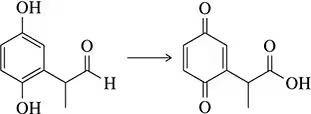
Suggest the reagents used to effect the transformations shown.
(a)

Verified step by step guidance
1
Identify the starting material and the product. The starting material is a hydroquinone with an aldehyde group, and the product is a benzoquinone with a carboxylic acid group.
Recognize the transformation involved: the conversion of the aldehyde group to a carboxylic acid group, and the oxidation of the hydroquinone to benzoquinone.
Consider the reagents typically used for oxidizing hydroquinones to benzoquinones. Common oxidizing agents include potassium dichromate (K2Cr2O7) or silver oxide (Ag2O).
For the conversion of an aldehyde to a carboxylic acid, a mild oxidizing agent such as Tollens' reagent (Ag(NH3)2+) or Jones reagent (CrO3, H2SO4) can be used.
Combine the knowledge of both transformations to suggest a reagent or a sequence of reagents that can achieve both the oxidation of the hydroquinone and the aldehyde to carboxylic acid. A strong oxidizing agent like potassium permanganate (KMnO4) in acidic conditions can be effective for both transformations.

Verified video answer for a similar problem:

This video solution was recommended by our tutors as helpful for the problem above.
Video duration:
2m
Was this helpful?

Key Concepts

Here are the essential concepts you must grasp in order to answer the question correctly.

Oxidation Reactions

Oxidation reactions involve the increase in oxidation state of a molecule, often by the addition of oxygen or the removal of hydrogen. In organic chemistry, oxidizing agents such as chromic acid or potassium permanganate are commonly used to convert alcohols or aldehydes to carboxylic acids or ketones. Understanding the role of oxidizing agents is crucial for predicting the outcome of such transformations.
Recommended video:
Guided course
03:20
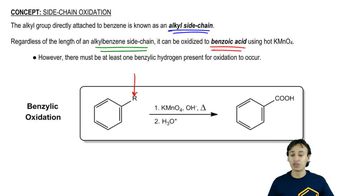
Benzylic Oxidation

Quinone Formation

Quinones are a class of cyclic organic compounds characterized by a fully conjugated cyclic dione structure. They are typically formed through the oxidation of phenols. In the given transformation, the conversion of a hydroquinone to a quinone involves the oxidation of the phenolic hydroxyl groups to carbonyl groups, which is a key step in the synthesis of quinones.
Recommended video:
1:47
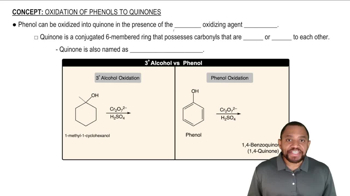
Oxidation of Phenols to Quinones Concept 1

Reagent Selection for Oxidation

Selecting the appropriate reagent for oxidation is critical in organic synthesis. Common reagents include PCC, PDC, and Jones reagent, each with specific applications and selectivity. For the transformation of hydroquinone to benzoquinone, reagents like silver oxide or ferric chloride are often used due to their ability to selectively oxidize phenolic groups without over-oxidizing the molecule.
Recommended video:
Guided course
03:51
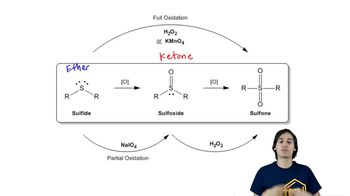
Reagents used to oxidize Sulfides.