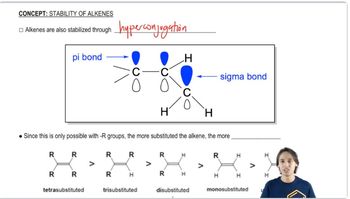
Rank the following alkenes in order of stability (1 = most stable; 5 = least stable). Explain your order.
Ch. 21 - Conjugated Systems I: Stability and Addition Reactions

Mullins1st EditionOrganic Chemistry: A Learner Centered ApproachISBN: 9780137566471Not the one you use?Change textbook
All textbooks
Mullins 1st Edition
Ch. 21 - Conjugated Systems I: Stability and Addition Reactions
Problem 3
Mullins 1st Edition
Ch. 21 - Conjugated Systems I: Stability and Addition Reactions
Problem 3Chapter 20, Problem 3
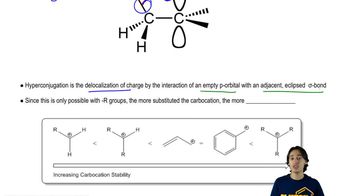
Rank the following carbocations in order of stability (1 = most stable; 5 = least stable ). Explain your order.

Verified step by step guidance1
Step 1: Analyze the structure of each carbocation and identify the type of carbocation (primary, secondary, tertiary, allylic, or benzylic). Carbocation stability is influenced by the number of alkyl groups attached to the positively charged carbon and resonance stabilization.
Step 2: Recognize that tertiary carbocations are more stable than secondary and primary carbocations due to hyperconjugation and inductive effects. Allylic and benzylic carbocations are stabilized by resonance, which can make them even more stable than tertiary carbocations.
Step 3: Examine the first structure. It is a primary carbocation, which is the least stable type because it lacks resonance stabilization and has minimal hyperconjugation.
Step 4: Examine the second structure. It is a tertiary carbocation, which is highly stable due to the presence of three alkyl groups providing hyperconjugation and inductive effects.
Step 5: Examine the third, fourth, and fifth structures. These are allylic carbocations. The third structure has resonance stabilization with one double bond, the fourth structure has resonance stabilization with one double bond and is tertiary, and the fifth structure has resonance stabilization with two double bonds and is tertiary. Rank them based on the extent of resonance and hyperconjugation effects.

Verified video answer for a similar problem:
This video solution was recommended by our tutors as helpful for the problem above.
Was this helpful?
Key Concepts
Here are the essential concepts you must grasp in order to answer the question correctly.
Carbocation Stability
Carbocation stability is influenced by the degree of alkyl substitution. Tertiary carbocations (three alkyl groups attached) are the most stable due to hyperconjugation and inductive effects, followed by secondary (two alkyl groups), primary (one alkyl group), and finally, methyl carbocations (no alkyl groups). The more alkyl groups surrounding the positively charged carbon, the more stable the carbocation.
Recommended video:
Guided course
Determining Carbocation Stability
Hyperconjugation
Hyperconjugation is a stabilizing interaction that occurs when the electrons in a sigma bond (usually C-H or C-C) interact with an adjacent empty p-orbital of a carbocation. This delocalization of electrons helps to distribute the positive charge over a larger area, thereby increasing the stability of the carbocation. The more hyperconjugative interactions available, the more stable the carbocation.
Recommended video:
Guided course
Understanding trends of alkene stability.
Inductive Effect
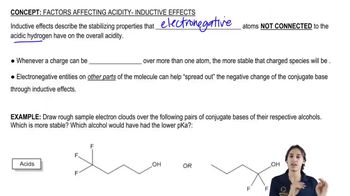
The inductive effect refers to the electron-withdrawing or electron-donating effects of substituents through sigma bonds. Alkyl groups are electron-donating, which helps to stabilize the positive charge of a carbocation. The presence of electronegative atoms or groups can destabilize a carbocation by pulling electron density away, making the understanding of inductive effects crucial for ranking carbocation stability.
Recommended video:
Guided course
Understanding the Inductive Effect.
Related Practice
Textbook Question
2
views
Textbook Question
Draw all possible resonance structures for the reactive intermediates shown.
(c)
1
views
Textbook Question
Draw all possible resonance structures for the reactive intermediates shown.
(b)
2
views
Textbook Question
Draw the molecular orbital picture of trans-but-2-ene. Be sure to label all σ and π bonds. Is there free rotation around the C₂― C₃ bond? Why or why not?
1
views
Textbook Question
Predict the product and provide a mechanism for the reaction of 1-methylcyclohexene with HBr.
\
1
views
Textbook Question
To this point, hydrogenation has always been an exothermic process. Using the numbers from Figure 21.6, calculate ∆Hohydr for each step of the reduction of benzene.
∆H1 + ∆H2 + ∆H3 = ∆Htot = ―49.5 kcal /mol (―208 kJ/mol)
1
views