Textbook Question
There were actually two possible products in the solvolysis reaction from Figure 21.10. Show both products. Which would you expect to be more stable? Why?
4
views

 Mullins 1st EditionCh. 21 - Conjugated Systems I: Stability and Addition ReactionsProblem 5
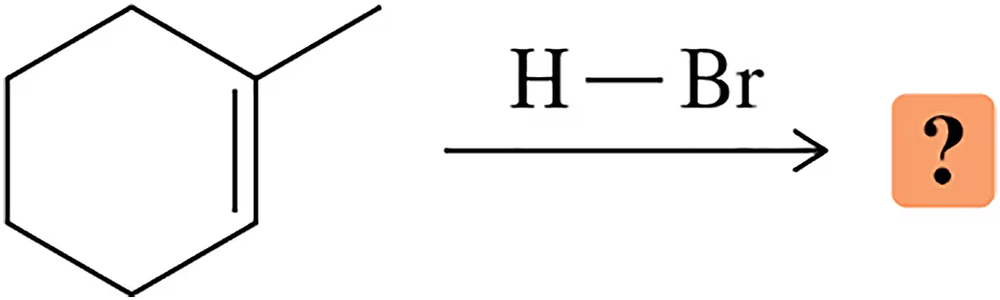 \
\ Verified step by step guidance
 09:23
09:23
 05:58
05:58 03:54
03:54There were actually two possible products in the solvolysis reaction from Figure 21.10. Show both products. Which would you expect to be more stable? Why?
Rank the following alkenes in order of stability (1 = most stable; 5 = least stable). Explain your order.
Draw all possible resonance structures for the reactive intermediates shown.
(c)
Rank the following carbocations in order of stability (1 = most stable; 5 = least stable ). Explain your order.
To this point, hydrogenation has always been an exothermic process. Using the numbers from Figure 21.6, calculate ∆Hohydr for each step of the reduction of benzene.
∆H1 + ∆H2 + ∆H3 = ∆Htot = ―49.5 kcal /mol (―208 kJ/mol)
Hydroboration, an electrophilic addition reaction like those studied in Section 21.4, only gives 1,2-addition to buta-1,3-diene, regardless of temperature. Why?