Ch. 21 - Conjugated Systems I: Stability and Addition Reactions
Mullins - Organic Chemistry: A Learner Centered Approach 1st Edition
Mullins1st EditionOrganic Chemistry: A Learner Centered ApproachISBN: 9780137566471Not the one you use?Change textbook
Chapter 20, Problem 4

Rank the following alkenes in order of stability (1 = most stable; 5 = least stable). Explain your order.                                                                                                                                                                                   Five structural formulas of alkenes are shown, illustrating their varying stability for comparison.

Verified step by step guidance
1
Step 1: Understand the concept of alkene stability. Alkene stability is influenced by the degree of substitution of the double bond. More substituted alkenes are generally more stable due to hyperconjugation and inductive effects.
Step 2: Analyze the structures provided. Count the number of alkyl groups attached to the carbon atoms of the double bond in each alkene. These groups contribute to the substitution level of the double bond.
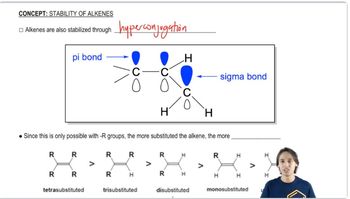
Step 3: Rank the alkenes based on substitution. For example, a tetrasubstituted alkene (four alkyl groups attached to the double bond) is more stable than a trisubstituted alkene, which is more stable than a disubstituted alkene, and so on.
Step 4: Consider additional factors such as steric hindrance and conjugation. Conjugation with adjacent π systems (like benzene rings or other double bonds) can increase stability, while steric hindrance can decrease it.
Step 5: Assign the stability ranking based on the above analysis. The alkene with the highest substitution and favorable conjugation will be ranked as the most stable (1), and the alkene with the lowest substitution or unfavorable steric effects will be ranked as the least stable (5).

Verified video answer for a similar problem:

This video solution was recommended by our tutors as helpful for the problem above.
Was this helpful?

Key Concepts

Here are the essential concepts you must grasp in order to answer the question correctly.

Alkene Stability

The stability of alkenes is primarily influenced by the degree of substitution at the double bond. More substituted alkenes (those with more alkyl groups attached to the carbon atoms of the double bond) are generally more stable due to hyperconjugation and the inductive effect, which help to stabilize the double bond. Therefore, the order of stability typically follows the trend: tetrasubstituted > trisubstituted > disubstituted > monosubstituted > unsubstituted.
Recommended video:
Guided course
04:28
Understanding trends of alkene stability.

Hyperconjugation

Hyperconjugation is a stabilizing interaction that occurs when the electrons in a sigma bond (usually C-H or C-C) interact with an adjacent empty or partially filled p-orbital or a pi-bond. In alkenes, this effect is particularly significant in more substituted alkenes, where the presence of additional alkyl groups allows for greater overlap and stabilization of the double bond, thus enhancing the overall stability of the alkene.
Recommended video:
Guided course
04:28
Understanding trends of alkene stability.

Inductive Effect

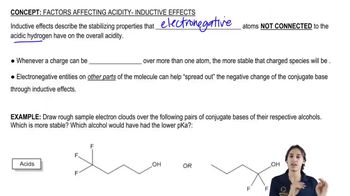
The inductive effect refers to the electron-donating or withdrawing effects of substituents through sigma bonds. Alkyl groups are electron-donating, which can help stabilize the positive charge that may develop in the transition state of reactions involving alkenes. This effect contributes to the increased stability of more substituted alkenes, as the electron-donating nature of the substituents reduces the overall electron deficiency at the double bond.
Recommended video:
Guided course
01:47
Understanding the Inductive Effect.